
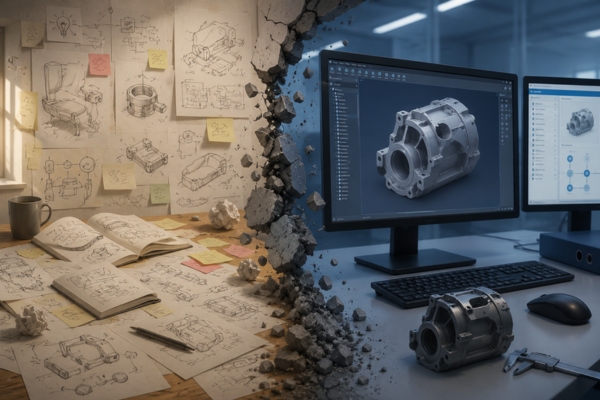
For a long time, engineering organizations thought all engineering data would, and should exist within either CAD, PDM, or PLM systems.
When problems arose, the logical solution was always,
“Let’s get it added into the CAD.”
“Let’s manage it using PLM.”
Companies tried. They configured the systems. They spent a lot of money doing so. However, it did not work very well. Not because CAD, PDM or PLM are poor systems, but because they were never intended to account for how Engineering starts its process.
The Attempt That Failed: Forcing Early Engineering into CAD
Traditional thinking assumed engineering starts with design.
In reality, engineering starts much earlier.
Before a single model is created, engineers already make critical decisions:
- Selecting components
- Computing capacities
- Making assumptions regarding design
- Deciding on specifications trade-offs
- Deciding cost vs performance
- Discussing with vendors
- Determining configurations for proposal stages
Organizations have attempted to push this work into PLM or CAD systems, but both CAD expects geometry and PLM expect released data. Because early engineering had neither, this led to:
- Engineers not using the system
- Data moving back to emails and Excel spreadsheets
- Only final product files are being sent to PLM
- The loss of true engineering logic.
Therefore, while there was a system, the workflow did not function properly.
Why This Problem Stayed Hidden for Years
In prior times, there were gaps that everyone was aware of, yet seemed invisible to them due to slow development as a result of having:
- Smaller teams
- Lower margins leaving room to compensate for inefficiencies
- Being able to absorb excess labour and resources
Companies managed through:
- Manual coordination
- Personal knowledge and experience
- Offline or outside of PLM to make decisions on products
PLM appeared incredibly effective when managing CAD data; however, there was no recording of engineering objectives in this process.
Why Today’s Generation Can Clearly See the Problem
Today, that same gap causes damage that can be seen. Engineering is not just separate from any of those groups; it is now working together with them on the complete engineering process.
- Sales
- Procurement
- ERP
- Cost and Margin Control.
When early Engineering is not managed,
- ERP will receive duplicate materials.
- Procurement will see conflicting specifications.
- Sales will commit to unvalidated configurations.
- Engineering will constantly remake the same decision.
Overall, what was once hidden and not measurable has now been made visible and costly.
Traditional PDM/PLM limitations
PDM and PLM are amazing tools for the tasks they were built to perform:
- CAD file management
- Revision Control
- BOM Release
- Tracking the Lifecycle of Products
They struggle with:
- Processes that occur before engineering starts
- Engineering data that is intended for business
- Collaboration across multiple functions/divisions
- Uncertainty at early stages of product development is not a configuration problem.
The design of the PDM/PLM system does not support these areas or types of processes.
Why an Intelligent Engineering Hub Was Needed
Forward-thinking organizations took a different approach and created a different system for engineering than using early CAD or PLM. They built a system to support the engineer’s decision-making before CAD and ERP systems.
This is where IEHUB.AI comes in.
IEHUB will never replace CAD, PDM, or PLM; however, it adds to each by allowing you to manage tasks outside of the capabilities of these systems.
PDM / PLM vs Intelligent Engineering Hub
| AREA | TRADITIONAL PDM/PLM | IEHUB.AI (Positioning) |
| System Nature | CAD- centred, engineering-based | Integrated engineering and business system. |
| Usability | Complex, Steep learning curves | Simple, Fast, Role- driven |
| Access Model | On-site or dependent on VPN connectivity | SaaS cloud-based with global accessibility |
| Collaboration | Mainly engineering- centered | Inter-team, cross-functional collaboration |
| Workflow Flexibility | Rigid and hard to change | Configurable and adjustable |
| System Integration | Difficult and slow | API first model for ERP/CAD |
| Data Consistency | Prone to duplicate and version conflicts | Centralized data source with structured data flow |
| Performance at Scale | Degrades in quality due to the massive size of the datasets. | High performance and cloud- scale design |
| Implementation Efforts | Long, Complicated, and High-risk | Rapid SaaS- based implementation |
| User Adoption | Limited outside engineering | Designed for enterprise-wide adoption |
| Customization Approach | Highly coded and tailored to your system’s requirements | Low code, Configuration-based |
| Pre- Engineering Support | Limited focus on finalized CAD data | strong support for pre-ERP Engineers. |
What Changes with IEHUB
With an Intelligent Engineering Hub:
- Early capture of engineering decisions
- Non-CAD users participate confidently
- Data is flowing into CAD, PLM, and ERP smoothly
- Less rework and duplication
- Reusable engineering knowledge.
Through this first implementation of Intelligent Engineering Hubs, Companies do not manage the results of engineering; instead, they manage the need for engineering.
Conclusion
The traditional CAD, PDM & PLM systems provided everything they were supposed to provide.
The only thing that failed was the belief that engineering begins with CAD. The digital and fast-paced engineer’s work today does not allow this belief to go unchallenged since it is very visible.
IEHUB is here because:
- Engineering at the start is important.
- Engineering and Business should always work in alignment.
- Not all things belong in CAD.
IEHUB does not replace any of your current systems.
IEHUB completes your Engineering Ecosystem.

Karthik S is our in-house Master Data Quality Manager certified by ISO-8000 for Data Quality and Enterprise Master Data. He comes with 10+ years of experience with prior experience in handling customer, asset & engineering data, improving data quality & accessibility, eliminating data loss and standardizing data to match industry standards.
