
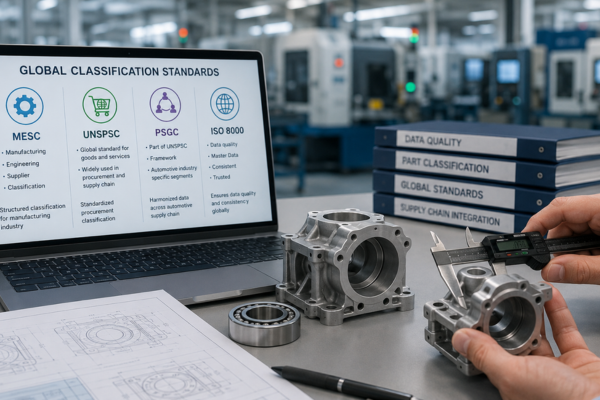
Material Classification affects more than just the administration of parts, but also affects the maintenance reliability, the efficiency of procurement, sourcing strategies, accuracy of the inventory, and integrity of the master data of an asset-intensive industry. Despite this, many organizations find themselves unable to resolve the primary concern of how to classify the same part across a number of different standards without producing issues such as confusion, duplication, and data pollution.
Many people assume that the MESC, PSGC, and UNSPSC are competing or overlapping standards, but they were all created for different business purposes. Companies run into issues when they try to force a standard to do what another standard is designed for. This blog will discuss how each of the four standards is different, how they can be used in combination with each other, and how to apply them in a multi-layer classification model by using an example from an engineering application.
Example Part Description
Let’s look at the following valve indication:
Gate Valve, 2″, Class 300, RF, ASTM A216 WCB, API 600, API 598, NACE MR0175, Manual Handwheel
Depending on your point of view, each line given here has multiple meanings:
- Engineering would like to know if there’s an exact technical match
- Maintenance would like to know if this part is a safe substitute
- Purchasing would like to know which type of product this belongs to
- Purchasing would like to know what commodity family it falls under
- Data Governance would like to know if the complete, consistent, and reusable
In addition, each of the classification standards interprets this same line in totally different ways.
Comparison of Classification Standards
Purpose Driven Comparison
Recommendations for Design: Use a full-width comparison table with light shading in the background that has soft grids or grid lines. Include an icon in the first column. This enhances the ability to quickly receive the information by executive-level audience members.
| Dimension | MESC | PSGC | UNSPSC | ISO 8000 |
| Primary Purpose | Exact engineering item standardization | Product, service grouping | Commercial procurement classification | Master data quality governance |
| Best Question Answered | What exact item is this? | What material family does this belong to? | What procurement category is this? | Is the data trustworthy? |
| Classification depth | Very high | medium | medium | Not a taxonomy |
| Granularity | Exact item | Commodity family | Commodity category | N/A |
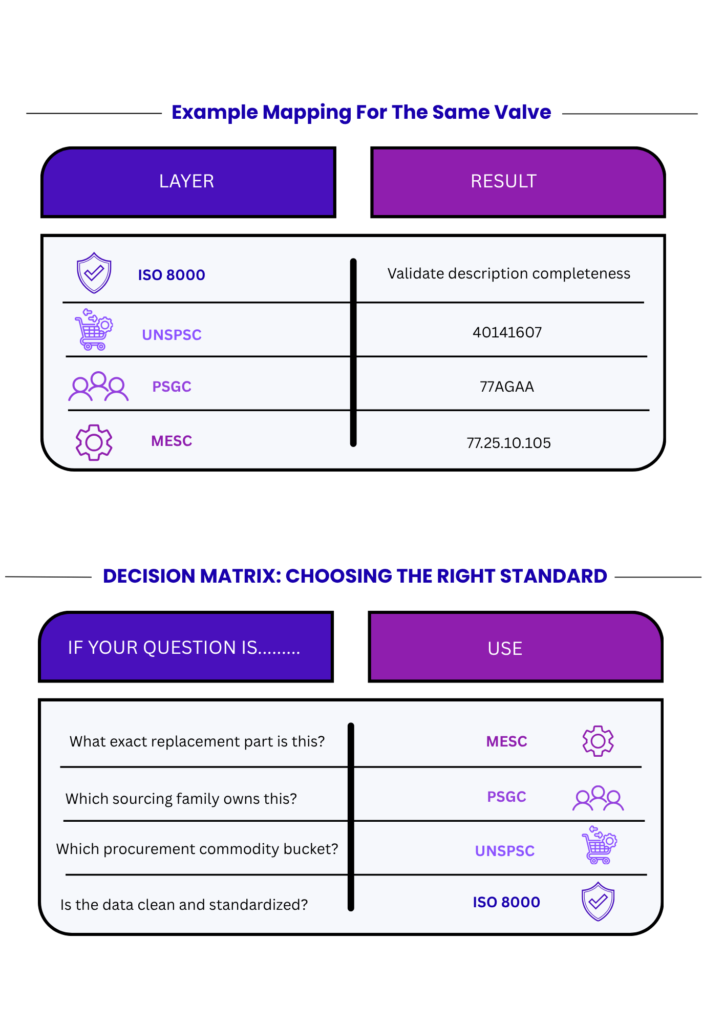
| Code example | 77.25.10.105 | 77AGAA | 40141607 | N/A |
| Captures exact size/ spec | Yes | No | No | Validates, doesn’t classify |
| Capture technical attributes | Yes | Partial | Minimal | Checks completeness |
| Supports spare part replacement | Excellent | Weak | Poor | No |
| Support engineering BOM | Excellent | Limited | Weak | No |
| Supports spend analysis | Moderate | Excellent | Excellent | Indirect |
| Supports sourcing strategy | Moderate | Excellent | Good | Indirect |
| Supports AVL/vendor grouping | Yes | Yes | Weak | No |
| ERP procurement category mapping | Good | Excellent | Excellent | Indirect |
| Cross-company interoperability | Weak | Limited | Excellent | Excellent |
| Duplicate prevention | Good | Weak | Weak | Excellent |
| Vendor neutrality | Low | Medium | High | High |
| Typical users | Engineering/Maintenance | Procurement/ sourcing | Procurement/ERP | Data Governance |
The Consistent Circumference of Every Standard
Display these four parts as cards/panels that are vertical with a unique color, icon, and title for each one. This presentation style works very well across websites, PDF’s, and slide decks.
- MESC – Exact Engineering Material Definition
Result: 77.25.10.105
The objective of MESC is to provide a definitive product definition for each piece of Equipment
i.e., What is this piece of Equipment?
The MESC definition provides a complete engineering definition or a complete technical specification for the Equipment being classified, to include:
- Valve Type and subtype
- Definitive Size and Pressure Class
- Connect Type
- Material used based on which part of the valve was constructed
- Standards Applicable, Specifications based on the geographical area where valves are to be installed
- Constraints in Service and Operating Parameters
Within each MESC, you will be able to identify:
- Size
- Pressure Class
- Connector Type
- Material
- Standards
- Constraints
Best Used For:
- Identification of Spares
- Requisition of Parts for Maintenance
- Execution of EPC Contracts
- Stacking at Warehouse
- Engineering Bill of Materials
MESC provides for detailed and rigid definitions to establish engineering integrity versus flexibility for MESC to allow for expeditious processing and relieve the supply chain of unnecessary inventory based upon the inability to reliably determine if 2 items are parts of each other.
- 2. PSGC – Grouping of Procurement and Sourcing Commodities
Outcome: 77AGAA
Example of family: Ball Valves, API/ANSI/BS, Carbon & Low, and High Alloy Steel
PSGC determines the sourcing family of the item, but it does not define the technical characteristics of the item.
Purpose
Develop a grouped collection of products/services/items in the same category for:
- Group ownership
- Developing sourcing strategies
- Aggregating purchased dollars
PSGC includes the following information to categorize a commodity(s) or service(s):
- Commodity family
- Sourcing family
- Spend family
PSGC does not contain the following information about a commodity(s) or service(s):
- Exact size
- Exact rating
- Exact trim
- Manufacturer-specificinformation on configuration
Best Used For
- Strategic sourcing
- Commodity management
- Supplier negotiations
PSGC answers the question:
Who is the sourcing team that has ownership of the material?
- UNSPSC – Global Procurement Classification
Result: 40141607
Definition: Gate Valve
The UNSPSC classification system details the following information as a result of a systematic process of classification:
Commercially available products
The UNSPSC does not include the following:
- Engineering details
- Technical specifications
The UNSPSC can be used for:
- Categorizing products and commodities in an ERP system
- Supplier product catalogues
- Reporting of purchases made
- Supporting interoperability between different businesses
The UNSPSC’s purpose is to determine “the general name that the market has conferred upon this item.
- ISO 8000 – Quality Governance for Master Data
ISO 8000 does not define classification codes but governs the quality of the description of the data.
ISO 8000 will validate the following:
- Is the description standardized?
- Are the required attributes present?
- Is the measurement unit defined?
- Is the item uniquely identifiable?
- Are there compatible suppliers to interpret the description?
ISO 8000 is best suited for:
- Master DataGovernance
- Duplication avoidance
- Quality of ERP data
- System-to-systeminteroperability
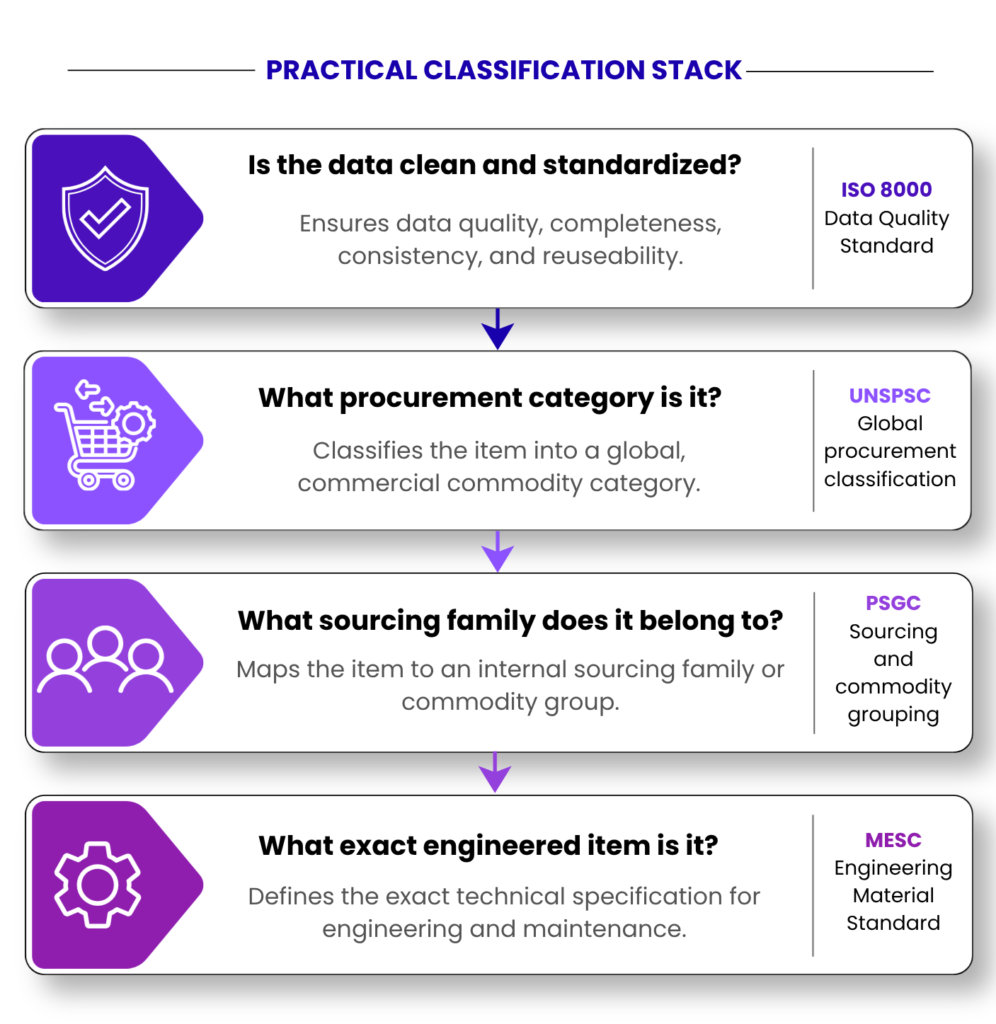
ISO 8000 will help ensure that whatever classification of data is applied, it is accurate, complete, and able to be used.
Common misunderstandings (and their differences)
MESC vs PSGC
Both are internal material identification codes, but they operate at different levels of abstraction:
- PSGC - a category
- MESC - an individual item.
Example:
- PSGC - Gate valves,
- MESC - this specific 2″ Class 300 RF valve.
PSGC vs UNSPSC
PSGC and UNSPSC both classify products, but for different purposes:
- PSGC is intended for internal procurement purposes,
- UNSPSC is for international sourcing purposes.
ISO 8000 vs all other codes
ISO 8000 does not replace any classification systems, but it provides quality standards for them.
Conclusion
Material Classification Is Not a Single Standard—but the Right Standard for the Given Question
A Material Classification System utilizes the following Standards:
- What the Market Calls It – UNSPSC
- What Sourcing Groups, It – PSGC
- What Engineering Defines It – MESC
- The Usefulness of the Data Description of It – ISO 8000
Organizations that align these standards accurately will increase the following:
- Decrease in Duplicate Items
- Decrease in Sourcing Cycle Time
- Increase in ERP Data Cleanliness
- Decrease in Maintenance Decision Safety
A Proper Classification System is a System and Not Just a Code.

With nearly two decades of experience in engineering, I bring deep expertise across both EPC (Engineering, Procurement, and Construction) and product-based OEM environments. My core strengths lie in engineering standardization, process optimization, and technical leadership. I have consistently driven excellence through the development and implementation of robust engineering frameworks, delivering value across global industrial projects and complex product lifecycles.
