
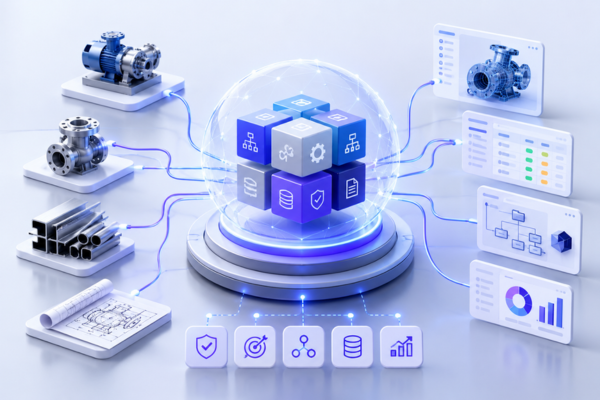
Accurate material master data is the foundation of every engineering organization. It supports product design, engineering proposals, Bills of Materials (BOMs), procurement, production, and inventory management. However, many organizations struggle with duplicate materials, inconsistent descriptions, missing attributes, and fragmented data across multiple systems, leading to higher costs, project delays, and reduced efficiency. As digital transformation accelerates, managing material data has become a strategic priority.
An Intelligent Material Information Management System (MIMS) helps organizations standardize, validate, and govern material information throughout its lifecycle, creating a trusted data foundation that improves collaboration, streamlines operations, and supports better engineering and business decisions.
Why Material Master Data Matters
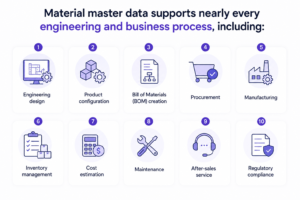
When material data is inaccurate, every downstream process is affected. Even a small error in a material record can lead to incorrect procurement, production delays, engineering rework, excess inventory, and poor business decisions.
High-quality engineering begins with high-quality data.
Common Challenges in Material Master Management
Although material data is critical, it is often managed across multiple departments and disconnected systems, creating inconsistent and unreliable information.
Duplicate Material Records
Duplicate material creation is one of the biggest challenges facing engineering organizations. It usually occurs because existing materials cannot be found, descriptions differ between departments, classification standards are missing, or material attributes are incomplete.
Duplicate records increase inventory costs, create procurement confusion, and reduce reporting accuracy.
Inconsistent Material Descriptions
Different teams often describe the same material in different ways. Without standardized naming conventions, searching becomes difficult, duplicate creation increases, procurement errors become more frequent, and collaboration suffers.
Manual Material Request Processes
Many organizations still rely on emails and spreadsheets for material creation. Requests typically pass through engineering validation, procurement review, master data verification, approvals, and ERP creation, making the process slow and resource-intensive.
Lack of Governance
Without defined ownership, validation rules, and approval workflows, required attributes are often missing, classifications become inconsistent, and data quality gradually declines.
Fragmented Engineering Systems
Engineering organizations typically use multiple systems, including CAD, PLM, ERP, procurement, manufacturing, and document management platforms. When these systems operate independently, maintaining synchronized material information becomes increasingly difficult.
What Is an Intelligent Material Information Management System?
An Intelligent Material Information Management System (MIMS) is a centralized platform that governs the complete lifecycle of engineering material master data.
Rather than simply storing material records, MIMS manages how materials are requested, validated, classified, approved, synchronized, and maintained across enterprise systems.
By combining workflow automation, engineering standards, intelligent search, and data governance, MIMS ensures every material record is accurate, complete, standardized, and reusable, creating a trusted engineering data foundation for the entire organization.
Key Capabilities of an Intelligent MIMS
Material Request Management
Every material begins with a request. Instead of relying on emails and spreadsheets, MIMS provides a structured workflow where users can submit material descriptions, technical specifications, required attributes, supporting documents, and business justifications.
This ensures requests are complete before entering the approval process, reducing delays and improving data quality from the start.
Intelligent Approval Workflows
Material creation involves multiple stakeholders, including engineering, procurement, master data teams, and management. MIMS automates approval workflows by routing requests to the appropriate reviewers, tracking approval status, recording decisions, and maintaining a complete audit trail.
This improves accountability while reducing manual effort.
AI-Assisted Duplicate Detection
Duplicate materials are one of the costliest data quality issues in engineering organizations. Traditional systems rely on manual searches, which often fail when descriptions vary.
MIMS uses AI-assisted duplicate detection to identify similar materials based on descriptions, technical attributes, classifications, specifications, manufacturers, and dimensions. Before creating a new record, users receive recommendations for existing materials that may already meet their requirements.
This reduces duplicate creation, improves inventory utilization, and enhances data quality.
Material Codification and Attribute Standardization
Consistent material codes are essential for procurement, inventory management, reporting, and engineering collaboration. MIMS standardizes material codification using predefined business rules, ensuring consistency across projects and business units.
The platform also enforces standardized attribute templates so every material record contains the required technical information, improving searchability, reporting, and engineering decisions.
Material Classification
Engineering organizations often manage thousands of material records. MIMS organizes materials into logical classifications based on product family, material type, function, industry standards, and technical characteristics.
Structured classification enables faster searches, improves consistency, and supports better engineering decisions.
AI-Assisted Material Search
Traditional keyword searches often fail because engineers describe materials differently.
MIMS uses AI-assisted search to understand engineering context rather than relying only on exact keywords. Users can search using technical descriptions, functional requirements, material properties, or partial information, allowing the system to recommend the most relevant materials quickly and accurately.
Synchronizing Engineering Data
Engineering and manufacturing rely on different Bills of Materials (BOMs). Engineering creates the Engineering Bill of Materials (EBOM), while manufacturing depends on the Manufacturing Bill of Materials (MBOM).
When these structures are not synchronized, procurement may order incorrect materials, manufacturing may use outdated components, and engineering changes can be missed.
MIMS keeps EBOM and MBOM synchronized, ensuring engineering updates flow seamlessly throughout downstream business processes.
The platform also integrates with leading CAD, PLM, and ERP systems, enabling automated material synchronization, BOM transfer, consistent product information, and reduced manual data entry. This creates a single source of truth for enterprise material data.
Business Benefits
Organizations implementing an Intelligent Material Information Management System can achieve significant improvements, including:
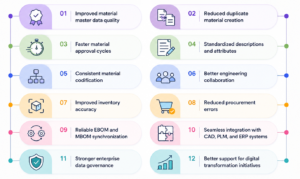
These benefits help reduce operational costs, improve engineering productivity, and enable more informed business decisions.
How IEHUB.AI Delivers Intelligent Material Information Management
IEHUB.AI provides a comprehensive Intelligent Material Information Management System (MIMS) that governs material master data throughout its lifecycle.
The platform enables organizations to:
- Manage intelligent material requests
- Automate approval workflows
- Detect duplicate materials using AI
- Standardized material codification
- Manage attributes and classifications
- Perform intelligent material searches
- Govern enterprise material data
- Integrate with CAD, PLM, and ERP systems
- Synchronize EBOMs, MBOMs, and material master records
Because MIMS integrates with IEHUB.AI’s Intelligent Lead Qualification, Engineering Proposal Management, and Product Standardization solutions, organizations can use standardized material information across the entire engineering lifecycle from customer enquiries and proposal preparation to product design, procurement, manufacturing, and after-sales support.
This unified approach ensures every department works from the same trusted engineering data, improving collaboration while reducing duplication.
Conclusion
Material master data is the foundation of successful engineering operations. Yet many organizations continue to struggle with duplicate records, inconsistent classifications, fragmented systems, and poor data governance.
An Intelligent Material Information Management System (MIMS) addresses these challenges by combining automation, governance, AI-powered search, and enterprise integration into a single platform.
With IEHUB.AI, organizations can standardize material data, automate workflows, enable intelligent material discovery, and synchronize information across CAD, PLM, ERP, and engineering systems. The result is higher-quality engineering data, improved operational efficiency, stronger collaboration, and a trusted digital foundation that supports long-term innovation and digital transformation.

With nearly two decades of experience in engineering, I bring deep expertise across both EPC (Engineering, Procurement, and Construction) and product-based OEM environments. My core strengths lie in engineering standardization, process optimization, and technical leadership. I have consistently driven excellence through the development and implementation of robust engineering frameworks, delivering value across global industrial projects and complex product lifecycles.
