
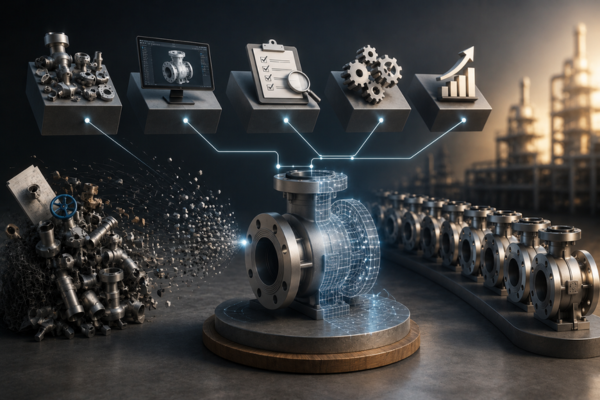
Engineering organizations are under constant pressure to deliver innovative, customer-specific products while reducing costs and shortening delivery timelines. Customers expect tailored solutions without compromising quality, reliability, or competitive pricing.
Many companies still rely on manual engineering practices where products are recreated for every project, engineering knowledge is scattered across documents and individuals, and product decisions depend on personal expertise. As organizations grow, these practices lead to repetitive engineering work, inconsistent product data, and difficulty maintaining engineering standards across teams.
The solution is not to eliminate customization; it is to standardize how customization is delivered.
Product Standardization & Engineering Management enables organizations to manage configurable products, engineering rules, product variants, technical documentation, and reusable engineering knowledge within a structured framework. Instead of designing every product from scratch, engineering teams can build on standardized product models and approved design rules to deliver faster, more accurate, and consistent solutions.
Why Product Standardization Matters
Customization is often viewed as a competitive advantage. However, excessive customization without standardization increases engineering effort, complicates procurement, creates manufacturing variability, and makes long-term maintenance more difficult.
Standardization allows organizations to meet unique customer requirements while maintaining consistency across engineering, manufacturing, procurement, pricing, and documentation. It is not about limiting innovation; it is about making innovation repeatable and scalable.
Common Challenges in Engineering Product Management
Many engineering organizations experience similar challenges as their product portfolios expand.
Repetitive Engineering Design
Engineers frequently redesign products that differ only slightly from previous projects. This results in:
- Increased engineering workload
- Longer project lead times
- Higher design costs
- Inconsistent engineering decisions
Instead of creating new value, engineers spend time repeating existing work.
Inconsistent Product Configurations
Without standardized configuration rules, similar customer requirements can produce different engineering solutions depending on who designs the product. This inconsistency affects proposal accuracy, manufacturing, procurement, service, and customer confidence.
Managing Product Variants
Industrial products often have hundreds or thousands of possible configurations based on size, material, capacity, voltage, pressure class, control systems, accessories, and regional standards. Managing these variants manually quickly becomes unmanageable.
Engineering Knowledge Loss
Critical engineering knowledge is often stored in personal spreadsheets, local files, emails, CAD libraries, and the experience of senior engineers. When experienced employees leave, valuable knowledge is lost, making future projects more challenging.
Documentation Challenges
Engineering documentation, including datasheets, specifications, design standards, installation guides, compliance documents, and testing procedures, can easily become inconsistent without centralized management.
What Is Product Standardization?
Product Standardization is the process of defining engineering products using reusable components, standardized rules, controlled configurations, and centralized technical knowledge.
Instead of treating every customer project as a new engineering exercise, organizations develop configurable product models that can be adapted efficiently while maintaining engineering integrity.
This approach creates consistency across engineering, manufacturing, procurement, sales, and service while providing a foundation for engineering automation.
Engineering Management Beyond Documentation
Engineering Management goes beyond storing drawings and documents. It manages the complete engineering knowledge required to develop, configure, validate, and maintain products throughout their lifecycle.
A modern engineering platform connects:
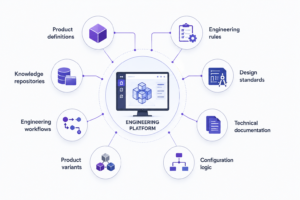
This ensures engineering decisions remain consistent across every project.
No-Code Product Configuration
Modern engineering platforms enable organizations to build configurable products without writing custom software.
Using intuitive business rules, engineering teams can define product options, technical constraints, compatibility rules, engineering calculations, commercial requirements, and regional standards without programming.
This allows engineering specialists, not software developers, to maintain product knowledge while reducing implementation time and improving flexibility.
Managing Configurable Products and Variants
Many industrial products, such as pumps, compressors, switchgear, control panels, valves, process skids, and automation systems, share common designs while supporting customer-specific variations.
A configurable product model enables organizations to define a master product while automatically applying engineering rules to generate valid product configurations.
Combined with intelligent variant management, organizations can control approved combinations, mandatory components, optional features, regional requirements, and customer-specific options. This reduces engineering errors while ensuring every configured product remains technically valid.
Engineering Rules and Reusable Knowledge
Experienced engineers rely on years of expertise when making design decisions. Unfortunately, much of this knowledge remains undocumented.
Engineering rules capture this expertise through reusable design logic such as:
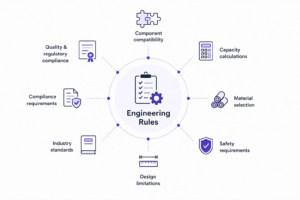
Every completed project also generates valuable knowledge through design improvements, lessons learned, technical solutions, and best practices.
By centralizing engineering knowledge, organizations reduce repetitive work, improve design consistency, and preserve expertise for future projects.
Technical Documentation and Compliance
Maintaining consistent technical documentation is essential for engineering quality.
A centralized engineering platform helps organizations generate standardized datasheets, manage document revisions, and maintain technical checklists that ensure compliance with engineering standards, customer specifications, industry regulations, and internal quality requirements.
Rather than relying on manual reviews, organizations can embed validation directly into engineering workflows, improving quality while reducing project risk.
Improving Engineering Collaboration
Engineering projects require collaboration between multiple departments, including mechanical, electrical, instrumentation, automation, manufacturing, procurement, sales, and product management.
A unified engineering platform gives every team access to the same product information, engineering rules, documentation, and configuration logic. This improves communication, reduces duplicated effort, and ensures consistent engineering decisions throughout the organization.
Business Benefits
Organizations implementing Product Standardization & Engineering Management can achieve significant operational improvements, including:
- Reduced engineering effort through reusable product configurations
- Faster product configuration and proposal preparation
- Consistent engineering decisions
- Better management of product variants
- Improved engineering quality and compliance
- Reduced engineering errors and rework
- Preservation of engineering knowledge
- Faster onboarding of new engineers
- Standardized technical documentation
- Better collaboration across departments
These improvements contribute to lower project costs, shorter delivery timelines, and improved customer satisfaction.
How IEHUB.AI Enables Product Standardization
IEHUB.AI provides a comprehensive Product Standardization & Engineering Management solution that transforms scattered engineering knowledge into standardized, reusable digital assets.
The platform enables organizations to:
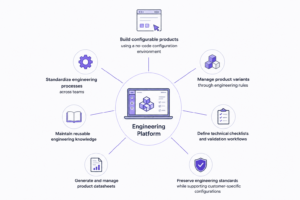
By integrating with Intelligent Lead Qualification, Engineering Proposal Management, and the Material Information Management System (MIMS), IEHUB.AI connects the complete engineering lifecycle from customer requirements and proposal generation to BOM creation, procurement, manufacturing, and enterprise data management.
Conclusion
Engineering excellence is no longer defined only by technical expertise; it depends on how effectively that expertise is standardized, shared, and reused across the organization.
Traditional engineering methods that rely on manual processes, isolated knowledge, and project-specific designs can no longer support today’s fast-paced engineering environment.
Product Standardization & Engineering Management provide a modern approach that balances customization with consistency, reduces repetitive engineering work, improves collaboration, and preserves valuable engineering knowledge.
With IEHUB.AI, organizations can build intelligent configurable products, centralize engineering knowledge, standardize technical processes, and create a connected engineering ecosystem that supports innovation, operational excellence, and sustainable business growth.

Palanivel Muthusamy is a seasoned expert in the Engineering, CAD, CAE, PLM, and PDM domains, boasting over 20 years of experience in project and product engineering within industrial companies. He holds both a Bachelor’s and a Master’s degree in Engineering, complemented by numerous certifications. Palanivel is highly proficient in engineering processes, including engineering change orders, notices, and quality processes, bringing a wealth of knowledge and hands-on expertise to the field.
