
Introduction
In modern industrial projects, a large quantity of materials and equipment must be obtained from several suppliers spread in various locations. Without a system of coding materials, organizations may encounter complications, such as repeated material records, errors in description and procurement, and other problems.
To address these issues, many industrial and energy organizations have standardized their particular systems for the creation of codes for materials. MESC is one of the first systems of this kind developed by Shell. It was created for the purpose of standardizing the identification of engineering materials and equipment in Shell’s worldwide operations.
Nowadays, many corporations either develop their systems of nomenclature of materials or refer to such standards as UNSPSC, eCl@ss, or ISO 8000. However, it should be noted that MESC continues to be a popular system.
What is MESC?
MESC is an abbreviation for Material and Equipment Standards Code. It is a systematic classification and coding system for materials, equipment, and spare parts. The main goals of MESC are as follows:
- Standardization of materials descriptions
- Removal of duplicate entries of different materials
- Increased accuracy of purchasing process
- Simplification of inventory management
- Consistency of materials globally
- Improvement of engineering data quality
MESC provides a common interface for material identification, making it unnecessary for every engineer or supplier to describe materials in their own way.
Why Was MESC Developed?
Before uniform coding systems came to be, organizations often came across numerous terminologies for the same object. For instance, a valve could have the following references:
- Ball Valve 2″ SS
- Stainless Steel Ball Valve DN50
- SS BV 2 Inch
- 2in Ball Valve Stainless Steel
Though all the terminologies refer to one valve, the systems might treat them as different objects. This results in a duplicate inventory, larger procurement costs, and poor quality of data.
MESC solves the issue by providing uniform descriptions and codes to every object in the material.
What Types of Materials Does MESC Cover?
MESC is a comprehensive list of engineering materials and devices that are typically used in industrial facilities. The following materials are included in this list:
- Pipes
- Pipe fittings
- Flanges
- Valves
- Pumps
- Heat exchangers
- Pressure vessels
- Tanks
- Structural steel
- Electrical equipment
- Instrumentation
- Cables
- Fasteners
- Gaskets
- Bearings
- Mechanical seals
- Safety equipment
- Spare parts
The detailed catalog helps to guarantee consistent identification of materials during engineering, procurement, construction, and maintenance processes.
How MESC Supports Engineering
The MESC facilitates communication among engineers.
When one chooses materials through the MESC code, everyone including the purchasing department, suppliers, warehouse workers, and maintenance departments knows the exact item needed.
This enhances collaboration and eliminates uncertainties in the project development process.
Benefits of Using MESC
Organizations using standardized material coding systems such as MESC have considerable improvements in their operations.
Improved Material Standardization
All material has the same description format, which eliminates confusion and enhances data quality.
Reduced Duplicate Materials
Duplicate materials cannot be created because engineers choose from existing standardized data.
Faster Procurement
Procurement departments can find the correct material, which reduces the number of requests and delays.
Better Inventory Management
Standardized material records make stock more visible and help organizations reduce stock presence.
Improved Reporting
Standard coding makes it possible for organizations to prepare accurate reports about material use, procurement expenses, and stock quantity.
Enhanced Global Collaboration
Organizations working in different locations benefit from a common language that provides better communication between engineering offices and project sites.
MESC vs. Material Descriptions
People commonly confuse MESC as just a reference name. In fact, MESC is an approach to material identification through the use of standardized definitions, defined specifications, and different codes. Instead of utilizing unstructured terms, companies tend to rely on fixed engineering details that guarantee uniformity.
MESC and Digital Engineering
As engineering firms embrace digitalization, the need for standard material data becomes indispensable.
- Digital engineering applications rely on consistent material data to accomplish:
- BOM Creation
- Master Material Administration
- Purchase automation
- Product Arrangement
- Cost Calculation
- Detection of duplicate materials
- Engineering Analytics
- ERP Linking
- Digital Twins
- Asset Management
Lacking standard material data, AI and automation will encounter issues when identifying the same materials or implementing smart engineering processes.
MESC Compared with Other Standards
MESC is one of several standards used to classify and manage engineering materials.
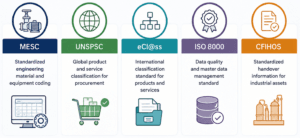
Many organizations use these standards together to support engineering, procurement, and enterprise data management.
Best Practices for Implementing MESC
Organizations that apply MESC or a similar standard for material coding should:
- Provide clear guidance on material governance.
- State the required engineering parameters for each type of material.
- Establish standard templates for material descriptions.
- Implement procedures for preventing duplicate materials from being created.
- Clean up and update material master data on a regular basis.
- Link material codes to ERP, PLM, and engineering systems.
- Train the engineering and purchasing teams regarding the coding standards.
- Use Artificial Intelligence for maintaining consistency and spotting duplicates.
The Role of AI in MESC-Based Material Management
Artificial Intelligence simplifies the process of maintaining standardized material master data.
AI can assist organizations:
- To standardize material descriptions
- To spot duplicates
- To determine attributes directly from documentation
- To propose material classification
- To compare material master data with the standardized one
- To check engineering requirements
- To improve the searching process in the material libraries.
These capabilities reduce manual effort while improving the quality and consistency of engineering data.
Conclusion
MESC makes a contribution towards assisting engineering companies to create standardized information on materials and equipment in complex projects. MESC provides data consistency in materials description and coding, which minimizes duplication, speeds up procurement, and enhances the quality of engineering data.
The digitalization of industries implies that MESC is still significant these days, and companies will benefit from using it even if it is implemented along with UNSPSC, eCl@ss, ISO 8000, etc. The crucial variable for gaining success is the availability of controlled, standardized, and correct engineering data.
Thanks to contemporary engineering tools based on AI technologies, companies have an opportunity to perform automated material standardization, ensuring high quality of master data.
About IEHUB.AI
IEHUB.AI supports engineering companies in creating high-quality master data on materials using an AI-based framework and implementing duplicate elimination and other necessary operations. The solution operates in compliance with such standards as UNSPSC, MESC, eCl@ss, ISO 8000, ERP, etc.

With nearly two decades of experience in engineering, I bring deep expertise across both EPC (Engineering, Procurement, and Construction) and product-based OEM environments. My core strengths lie in engineering standardization, process optimization, and technical leadership. I have consistently driven excellence through the development and implementation of robust engineering frameworks, delivering value across global industrial projects and complex product lifecycles.
