
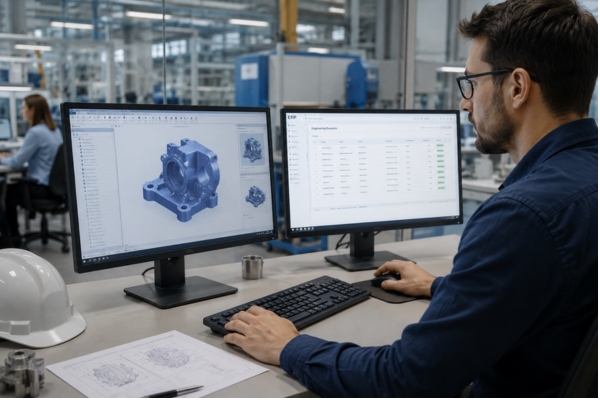
Every EPC and OEM organization depends on reliable material data in the ERP System. From design and procurement to inventory, maintenance, and operations, every decision begins with accurate material information.
Yet many organizations continue to struggle with duplicate materials, inconsistent descriptions, scattered engineering documents, and poor material reuse even after implementing an ERP system.
The reason is simple: Material Master Data is only as good as the information used to create it.
Before a material becomes an approved record in the ERP, it must be identified, classified, described, validated, enriched, and governed. This is where Material Intelligence plays a critical role.
IEHUB (Intelligent Engineering Hub) brings Material Intelligence and Material Master Data together in a single platform, helping organizations create trusted material information before it is published to ERP.
The Material Data Challenge
Most organizations already have an ERP Material Master. However, engineering teams often create material information outside the ERP using spreadsheets, emails, vendor catalogs, legacy databases, and shared folders.
This disconnected approach creates several challenges:
- Duplicate material records
- Inconsistent material descriptions
- Missing engineering attributes
- Scattered technical documents
- Difficult material searches
- Poor material reuse
- Weak data governance
As these issues accumulate, the quality of Material Master Data declines, affecting engineering efficiency, procurement, inventory, and maintenance.
Material Intelligence and Material Master Data: One Connected Process
Material Intelligence and Material Master Data are not separate initiatives; they are two stages of the same material lifecycle.
Material Intelligence focuses on creating high-quality engineering information by enabling intelligent search, classification, standardization, enrichment, validation, and governance.
Once that information is verified and approved, it becomes Material Master Data, which is then managed by the ERP to support procurement, inventory, manufacturing, maintenance, and finance.
In other words, Material Intelligence creates trusted material information. Material Master Data manages it across the enterprise.
How IEHUB Connects the Entire Material Lifecycle
IEHUB combines Material Intelligence capabilities with Material Master Data management, enabling organizations to manage the complete journey from engineering request to ERP-ready material records.
Intelligent Material Search
Before creating a new material, engineers can search existing materials using keywords, engineering attributes, technical specifications, taxonomy, and AI-powered semantic search.
This improves material discovery, encourages reuse, and reduces duplicate material creation.
Material Classification and Taxonomy
IEHUB organizes materials using standardized classification structures and taxonomies, ensuring consistency across projects, departments, and business units.
A common classification framework makes materials easier to search, compare, and manage.
Standardized Material Descriptions
Using the Material Description Generator (MDGen), IEHUB automatically generates consistent, standards-based material descriptions.
Standardized descriptions improve search accuracy, simplify procurement, and enhance the quality of Material Master Data.
Engineering Data Enrichment
A material is more than a material number.
IEHUB centralizes all related engineering information, including:
- Technical specifications
- Engineering drawings
- Vendor datasheets
- Certifications
- Material attributes
- Supporting documents
This gives engineers complete visibility into every material from a single platform.
Duplicate Detection
IEHUB compares new material requests with existing records using descriptions, classifications, and engineering attributes.
Potential duplicates are identified before approval, preventing unnecessary material creation and reducing inventory duplication.
Material Governance
Built-in validation rules, approval workflows, and quality checks ensure that every material follows organizational standards before publication.
This creates trusted, consistent, and well-governed material information.
ERP Publishing
Once validated and approved, IEHUB publishes clean, standardized Material Master Data to the ERP, ensuring downstream business processes operate with accurate and reliable information.
Why This Integrated Approach Matters
Managing Material Master Data without Material Intelligence often results in poor-quality records being entered into the ERP. Correcting these issues later is time-consuming, expensive, and disruptive.
By integrating Material Intelligence with Material Master Data management, IEHUB helps organizations improve data quality before it impacts engineering and business operations.
The result is:
- Higher-quality Material Master Data
- Reduced duplicate materials
- Improved material reuse
- Faster engineering workflows
- Better procurement decisions
- Stronger data governance
- Lower inventory and purchasing costs
- Greater confidence in ERP data
Conclusion
Material Intelligence and Material Master Data are not competing concepts; they are complementary stages of the same material lifecycle.
Material Intelligence ensures material information is searchable, standardized, enriched, validated, and governed. Material Master Data ensures that approved information supports enterprise operations efficiently.
IEHUB brings these capabilities together in one intelligent engineering platform. By connecting engineering data with enterprise systems, IEHUB enables organizations to build trusted Material Master Data, improve engineering productivity, and maximize the value of their ERP investment.
From engineering request to ERP-ready Material Master Data, IEHUB manages the complete material lifecycle with intelligence, consistency, and governance.

Karthik S is our in-house Master Data Quality Manager certified by ISO-8000 for Data Quality and Enterprise Master Data. He comes with 10+ years of experience with prior experience in handling customer, asset & engineering data, improving data quality & accessibility, eliminating data loss and standardizing data to match industry standards.
