
Introduction
EPC enterprises and Original Equipment Manufacturers benefit from ERP’s ability to integrate a variety of processes, including engineering, procurement, production, inventory management, costing, sales, and financial management. However, all these processes hinge upon an important requirement: correct material master data.
If the material data is inadequate, inconsistent, or duplicated, the material data problem reaches beyond engineering all the way to procurement, inventory, and project execution, thus creating a disintegrated business ecosystem.
As such, material data cleansing and enrichment should be considered an engineering and business transformation exercise, rather than merely an ERP data migration process.
- The Material Data Problem Starts Before ERP
In an EPC or OEM environment, material data can originate from multiple sources, including:
- Engineering specifications
- P&IDs
- Equipment datasheets
- BOMs
- BOQs
- CAD systems
- PLM/PDM systems
- Vendor documents
- RFQs
- Purchase specifications
- Previous projects
- Customer specifications
- Excel files
- Legacy ERP systems
The same component may be described differently across each source.
For example:
PIPE, CS, 4″, SCH 40
could appear elsewhere as:
- 4 IN CS PIPE SCH40
- PIPE 100NB CARBON STEEL SCH 40
- CS PIPE 100 NB ASME B36.10
The engineering meaning may be similar, but the ERP can see them as different strings unless the data is standardized.
This creates the need for a structured material intelligence process before the data reaches ERP.
- Material Cleansing Is Not Just ERP Migration
ERP implementation projects often focus heavily on:
- Data migration
- Field mapping
- Material code conversion
- Data loading
However, simply migrating existing material records does not solve the underlying data problem.
If the legacy system contains:
- Duplicate materials
- Missing attributes
- Incorrect classifications
- Inconsistent units
- Poor descriptions
- Unstructured specifications
then migrating those records simply transfers the problem into the new ERP.
A better approach is:
Extract → Profile → Cleanse → Classify → Enrich → Validate → Standardize → Approve → Load into ERP
This turns ERP migration into an opportunity to create a clean engineering data foundation.
- Engineering Standardization
For EPCs and OEMs, one of the biggest benefits of material enrichment is engineering standardization.
Different engineers often use different methods to describe the same component.
For example:
- MOTOR 5HP
- MOTOR 3.7KW
- AC MOTOR 3.7 KW
- MOTOR, 415V, 3PH, 50HZ, 3.7KW
A standardized attribute structure can define the material as:
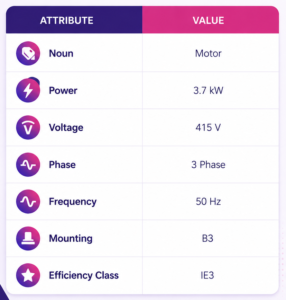
Now, the material is no longer just a description. It becomes structured engineering information.
- Better BOM Creation
BOM quality depends heavily on material master quality.
If engineers cannot easily identify existing materials, they tend to create new material records or use free-text descriptions. This creates BOM inconsistency.
For example, across multiple projects:
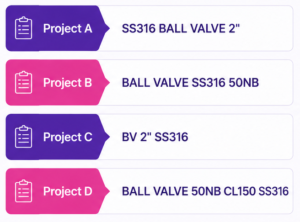
A material intelligence system can identify the common engineering characteristics and determine whether these represent:
- The same material
- Different variants
- Equivalent materials
- Related materials
This allows EPCs and OEMs to create cleaner and more reusable BOMs.
- Engineering Reuse Across Projects
EPC companies repeatedly execute similar projects, while OEMs repeatedly manufacture similar products.
Yet engineering teams often recreate material selections from scratch because historical material data is difficult to search.
A standardized material master enables engineers to search based on engineering characteristics rather than exact text.
For example:
Pump → Centrifugal → 100 m³/hr → 40 m Head → SS316
can return previously approved materials and assemblies.
This allows organizations to reuse:
- Materials
- Components
- Equipment
- BOM structures
- Specifications
- Datasheets
- Approved manufacturers
This can significantly reduce repetitive engineering work.
- Faster Procurement
Once material data is standardized, procurement becomes more efficient.
Instead of receiving an unclear description such as:
“VALVE SS 2 INCH”
the buyer can receive structured information:
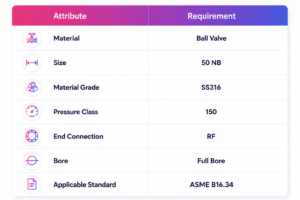
This reduces ambiguity between engineering and procurement and improves:
- RFQs
- Vendor comparisons
- Purchase orders
- Technical bid evaluations
- Supplier communication
- Better Vendor Comparison
EPC and OEM procurement teams often compare multiple suppliers for the same requirement.
If material requirements are poorly structured, comparing vendor offers becomes difficult.
A standardized material model allows procurement teams to compare suppliers using common engineering attributes.
For example, a valve requirement can be compared based on:
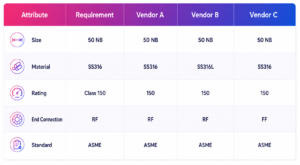
Now, the technical and commercial comparison becomes much easier.
- Cost Estimation Becomes More Reliable
For EPCs and OEMs, material data directly influences project costing.
If the same material appears under multiple codes, historical pricing becomes fragmented.
For example, SS316 Ball Valve 2″ may have been purchased at different prices under several material codes.
This makes it difficult to determine:
- Historical purchase price
- Average purchase price
- Latest price
- Supplier price
- Price trend
- Standard cost
- Estimated project cost
A standardized material master creates a stronger foundation for cost estimation, historical pricing, and procurement analysis.
- Better Project Cost Control
For EPC companies, material cost is often a significant component of project cost.
If material information is inconsistent, project cost reporting becomes less reliable.
A clean material master enables organizations to connect:
Engineering Requirement → Material → Purchase Order → Receipt → Inventory → Project Cost
This creates better cost visibility across projects.
Project teams can understand:
- Planned material cost
- Actual purchase cost
- Price variance
- Quantity variance
- Material consumption
- Material wastage
- Procurement savings
- Manufacturing Benefits for OEMs
For OEM organizations, material standardization provides another major benefit:
Product standardization.
OEMs often manufacture configurable products with:
- Multiple sizes
- Multiple materials
- Multiple ratings
- Multiple motor options
- Multiple control options
- Multiple accessories
Without a structured material master, every product configuration can create new and potentially duplicate components.
With a standardized material model, OEMs can create reusable component libraries.
For example:
Pump
→ Pump Type
→ Capacity
→ Head
→ Material
→ Motor
→ Seal
→ Coupling
→ Base Frame
→ Accessories
Each component can be linked to a standardized material record.
- Product Configurators Need Clean Material Data
Modern OEMs increasingly use product configurators.
A configurator may allow a customer or sales engineer to select:
Product → Size → Capacity → Material → Motor → Accessories
The system can then generate:
- BOM
- Cost
- Price
- Datasheet
- Technical specification
- Manufacturing requirements
However, this level of automation is only possible when the underlying material data is standardized.
Product configuration automation starts with material master standardization.
- Better Manufacturing BOMs
For OEMs, the material master forms the foundation of manufacturing BOMs.
Duplicate or poorly classified components can lead to:
- Multiple part numbers for the same component
- Purchasing the wrong component
- Increased inventory
- Manufacturing confusion
- Difficulty maintaining BOMs
- Higher engineering effort
A standardized material structure allows manufacturers to distinguish between:
Common Components
and
True Product Variants.
This supports modular product design and engineering reuse.
- Inventory Optimization
The benefits of material standardization continue after procurement.
If materials are standardized, inventory can be analyzed more effectively.
EPCs can identify materials that exist across multiple projects, while OEMs can identify common components shared across product families.
Organizations can gain better visibility into:
- Common materials
- Project-specific materials
- Slow-moving materials
- Excess inventory
- Obsolete materials
- Reusable stock
- Critical components
Instead of treating inventory as isolated material codes, organizations can understand the relationship between materials and their actual engineering meaning.
- Reducing Duplicate Material Creation
One of the most important capabilities for an EPC or OEM is preventing duplicates before they enter ERP.
A controlled process can follow this workflow:
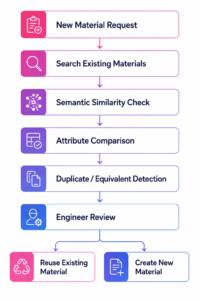
This changes the approach from:
Clean duplicates later
to:
Prevent duplicates at the point of creation.
That is a much more sustainable model.
- Better Engineering-to-ERP Integration
Many organizations operate separate systems for:
- CAD
- PDM
- PLM
- Engineering
- Procurement
- ERP
The material master is often the bridge between these systems.
If material data is inconsistent, integration becomes difficult.
A standardized material model can provide a common language between:
Engineering ↔ PLM/PDM ↔ Procurement ↔ ERP ↔ Manufacturing
This enables a stronger digital thread across the organization.
- Faster ERP Implementation and Migration
Material cleansing becomes especially valuable during ERP implementation or migration.
Organizations may discover that decades of legacy data contain:
- Millions of records
- Duplicate materials
- Inconsistent naming
- Missing attributes
- Multiple units
- Obsolete materials
- Incorrect classifications
Simply migrating all records can be expensive and risky.
A structured cleansing program can categorize records into:
Keep → Merge → Enrich → Retire → Create New
This improves the quality of the ERP migration and establishes a stronger material foundation from the beginning.
- Better Analytics and AI
There is another increasingly important reason to standardize material data:
AI requires structured and reliable data to produce reliable results.
Organizations increasingly want to use AI for:
- Procurement recommendations
- Material search
- Duplicate detection
- Cost estimation
- BOM generation
- Demand forecasting
- Supplier recommendations
- Inventory optimization
- Engineering reuse
However, AI cannot reliably reason over highly inconsistent material descriptions without understanding the underlying structure.
A standardized material model provides the foundation for AI-driven engineering and supply-chain automation.
- From Material Master to Engineering Intelligence
The future is not simply about having a clean ERP material master.
The objective is to build a material intelligence layer that understands the engineering meaning of every material.
For example:
“BALL VALVE 50NB SS316 CL150 RF”
should not be treated simply as a text string.
The system should understand:
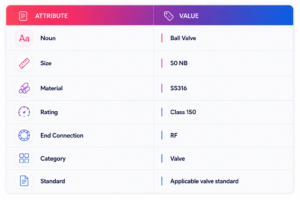
Once this information is structured, the organization can perform much more intelligent operations.
It can:
- Search
- Compare
- Detect duplicates
- Identify alternatives
- Recommend existing materials
- Calculate costs
- Generate BOMs
- Support procurement
- Connect engineering to ERP
- The Complete EPC/OEM Material Data Lifecycle
A mature material data process can follow this lifecycle:
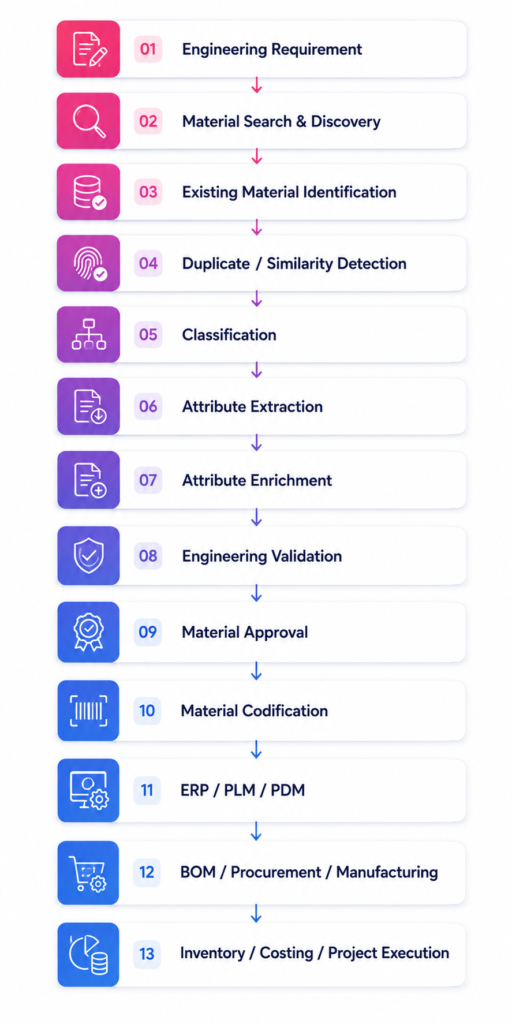
This turns material management into a controlled engineering lifecycle rather than an ERP data-entry activity.
- Business Benefits of Material Master Standardization
Engineering
- Faster material selection
- Reuse of previous engineering
- Standardized specifications
- Reduced repetitive work
- Better BOM quality
Procurement
- Clearer RFQs
- Better supplier comparison
- Better sourcing
- Reduced duplicate purchases
- Improved negotiation leverage
Project Management
- Better cost estimation
- Improved material cost control
- Better project visibility
- Reduced procurement delays
Manufacturing
- Standardized manufacturing BOMs
- Higher component reuse
- Reduced part-number proliferation
- Better production planning
Inventory
- Better stock visibility
- Reduced duplicate inventory
- Improved material reuse
- Lower excess and obsolete inventory
ERP
- Cleaner material master
- Better reporting
- Better analytics
- More reliable integrations
AI & Automation
- Better semantic search
- More accurate duplicate detection
- Automated BOM generation
- Intelligent material recommendations
- Automated engineering workflows
Conclusion
For EPC and OEM organizations, material master data sits at the intersection of engineering, procurement, costing, manufacturing, inventory, and ERP.
If that data is inconsistent, every downstream process becomes more difficult.
But when material data is:
Cleansed → Standardized → Classified → Enriched → Validated → Governed, it becomes much more than an ERP master record.
It becomes a reusable engineering asset.
The real transformation is moving from:
Material Codes
to
Structured Engineering Materials
and ultimately to:
Material Intelligence.
For EPCs, this means faster engineering, better procurement, more accurate costing, and greater project execution efficiency.
For OEMs, it means standardized products, reusable components, better BOMs, optimized inventory, and a stronger foundation for product configuration and automation.
And for both, the long-term goal is the same: turning material data into engineering intelligence that can drive the entire business.

Karthik S is our in-house Master Data Quality Manager certified by ISO-8000 for Data Quality and Enterprise Master Data. He comes with 10+ years of experience with prior experience in handling customer, asset & engineering data, improving data quality & accessibility, eliminating data loss and standardizing data to match industry standards.
