

Introduction
In the case of large-scale asset-intensive organizations like oil and gas companies, refineries, petrochemical plants, and process plants, ERP systems form the backbone of all essential business activities like procurement, inventory control, maintenance, warehousing, finance, and asset management. However, there remains one crucial question that businesses fail to ask themselves.
What is the dependability of the ERP material data?
One might think that the ERP tool is good enough and has sufficient integrations along with full-featured workflows. However, if the material master of the ERP is full of duplicates, no information, contradictory information, or unclassified records, the company might still experience troubles with the purchase process, inventory management, maintenance operations, and asset reliability.
For instance, a 2-inch stainless steel valve can be listed in the ERP system with different descriptions
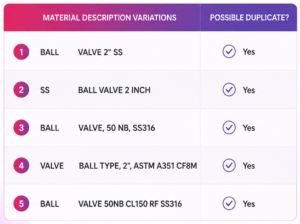
These records may represent the same or very similar material.
The issue is not simply that the descriptions are different. The real problem is that the organization may lose the ability to reliably identify, compare, procure, stock, and reuse materials.
This is why material cleansing, standardization, classification, and enrichment should be treated as a strategic ERP data initiative rather than simply a data-cleaning exercise.
- ERP Does Not Fix Poor Material Data
ERP systems are designed to manage business processes such as:
- Purchase requisitions
- Purchase orders
- Goods receipts
- Inventory
- Material issues
- Maintenance orders
- Work orders
- Vendor management
- Material valuation
- Stock movements
- Financial transactions
However, an ERP system cannot automatically determine that:
“SS BALL VALVE 2 INCH”
and
“BALL VALVE 50NB SS316 CL150 RF”
may refer to the same material unless the underlying data has been properly structured and enriched.
When poor material data enters an ERP system, the ERP simply becomes an efficient system for managing poor-quality data.
Therefore:
ERP process automation depends on material master data quality.
- What Does Material Cleansing Actually Mean?
Material cleansing is more than correcting spelling mistakes.
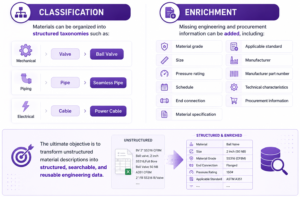
A mature material data program typically involves four major layers:
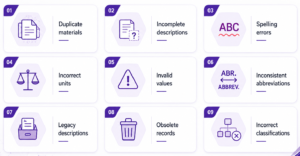
Data Cleansing
This involves identifying and correcting
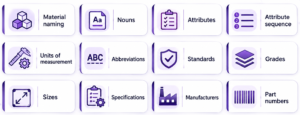
Standardization
Organizations need consistent rules for:
- HowPoor Material Data Impacts Procurement
Procurement is one of the initial business processes suffering from inefficient item creation.
Whenever there are repetitive or poorly defined items, there might be confusion regarding whether an available item meets a new demand. Therefore, procurement teams introduce additional item codes instead of using the existing ones.
The cycle begins with:
New Demand → Bad Search → New Item Code → Repetitive Item → Increased Quantity → Increased Complexity of Information.
As time passes, the quantity of item records can increase considerably.
After using a well-organized and rich item master, procurement can make searches according to certain parameters.
For instance:
Ball Valve → 2” → SS316 → Class 150 → RF → Full Bore
This makes the search for existing items easier.
- Better Material Reuse Means Better Procurement
Material reuse has a direct impact on procurement efficiency.
When the same or equivalent material is represented by multiple material codes, procurement teams may unknowingly purchase materials that already exist elsewhere in the organization.
This can result in:
- Unnecessary purchases
- Increased supplier transactions
- Lower purchasing leverage
- Fragmented spend
- Increased inventory
- Missed framework agreements
- Difficulty consolidating demand
A standardized material master allows organizations to aggregate demand.
For example, instead of purchasing:
- 50 units under Material A
- 100 units under Material B
- 75 units under Material C
the organization may discover that all three records represent the same standardized material.
This creates an opportunity to consolidate demand and potentially negotiate better commercial terms.
- Improving Inventory Management
Inventory accuracy is not only about counting physical stock. It is also about knowing what the stock actually represents.
Consider three warehouses:
- Material A — 12 units
- Material B — 8 units
- Material C — 15 units
If all three records represent the same valve, the organization may believe that it has three separate inventory positions.
In reality, it may have:
35 units of one material.
Without standardized material data, inventory visibility becomes fragmented.
Material cleansing and enrichment can help identify:
- Duplicate inventory
- Similar materials
- Equivalent materials
- Obsolete materials
- Slow-moving materials
- Excess stock
- Potentially interchangeable spares
This creates an opportunity to optimize inventory across plants, warehouses, and business units.
- Making Maintenance and MRO More Efficient
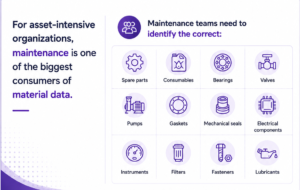
- Creating Better Spare-Part Visibility Across Plants
Large asset owners may operate multiple:
- Refineries
- Processing plants
- Terminals
- Offshore facilities
- Onshore facilities
- Warehouses
- Maintenance locations
The same spare may exist at different locations under different material codes.
Without standardized material data, one facility may purchase a material while another facility already has excess stock.
A centralized material intelligence layer can help answer questions such as:
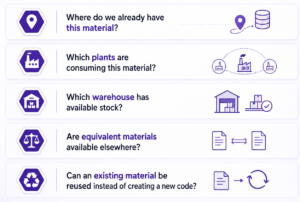
This transforms inventory from a collection of isolated warehouses into an enterprise-wide material network.
- The Role of Material Data in Shutdown and Turnaround Management
Shutdowns and turnarounds can create significant demand for materials.
Thousands of spare parts, consumables, and maintenance items may need to be identified and procured within a limited period.
Poor material data can lead to:
- Duplicate procurement
- Wrong material selection
- Procurement delays
- Emergency purchases
- Expedited freight
- Excess post-shutdown inventory
A clean material master allows shutdown planners to identify and consolidate requirements earlier.
Organizations can determine:
Required Quantity → Existing Stock → Available Stock Elsewhere → Open PO → New Procurement Requirement
This improves planning and reduces last-minute procurement.
- Improving Supplier and Spend Analysis
Material standardization also improves spend visibility.
When the same material is represented by multiple descriptions and codes, spend analysis becomes fragmented.
For example, the category Valve may appear under dozens of different material descriptions.
As a result, procurement teams may not have a clear view of total enterprise spending for that material category.
With standardized classification and attributes, organizations can analyze:
- Spend by material category
- Spend by manufacturer
- Spend by specification
- Spend by plant
- Spend by supplier
- Consumption trends
- Price trends
- Equivalent materials
- Supplier concentration
This enables more strategic sourcing decisions.
- Supporting Supplier Rationalization
Material enrichment can also help organizations understand whether multiple suppliers are supplying essentially the same material.
For example:
Ball Valve → 2″ → SS316 → Class 150 → RF
Once material characteristics are standardized, procurement teams can compare suppliers based on:
- Price
- Quality
- Lead time
- Reliability
- Historical performance
- Approved vendor status
- Manufacturer
- Part number
This supports supplier rationalization and strategic sourcing.
- Material Data and Asset Reliability
Material data also has an operational reliability dimension.
Selecting the wrong spare part can result in:
- Maintenance delays
- Equipment downtime
- Rework
- Emergency procurement
- Increased maintenance cost
- Extended shutdowns
For critical equipment, knowing exactly which material is required is essential.
Enriched material data can connect:
Asset → Equipment → BOM → Spare Part → Specification → Manufacturer → Part Number
This creates a stronger digital thread between asset management and material management.
- The Hidden Cost of Duplicate Materials
The cost of duplicate materials is rarely visible as a single line item.
Instead, it appears across multiple departments:
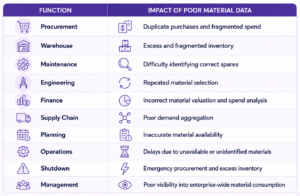
This is why material master data should be considered an enterprise business asset, not simply an ERP administrative record.
- From Material Cleansing to Material Intelligence
Traditional data cleansing is often treated as a one-time project.
But material data continuously changes.
New materials are created.
New suppliers are added.
New specifications are introduced.
Engineering teams create new requirements.
Plants generate new maintenance requirements.
Therefore, organizations need to move from:
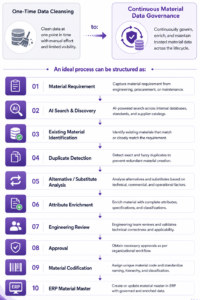
This creates a controlled process for introducing new materials into the ERP environment.
- The Business Case for Material Data Quality
For large asset owners, the business case should go beyond simply achieving “better data.”
The benefits can extend across multiple business functions.
Procurement
- Higher material reuse
- Better demand consolidation
- Improved supplier negotiations
- Reduced duplicate purchases
Inventory
- Reduced duplicate stock
- Better warehouse utilization
- Improved inventory visibility
- Lower excess and obsolete inventory
Maintenance
- Faster spare identification
- Reduced maintenance delays
- Better equipment BOMs
- Improved spare-part planning
Supply Chain
- Better demand forecasting
- Improved material availability
- Better supplier planning
Finance
- Improved spend visibility
- Better inventory valuation
- More accurate category-level analysis
Operations
- Reduced material-related downtime
- Faster maintenance execution
- Better shutdown readiness
- Creating a Digital Material Foundation
ERP should not be treated as the place where material data problems are solved.
Ideally, the material master should be standardized before the material becomes part of the ERP ecosystem.
A modern architecture can establish a material intelligence layer between engineering, procurement, and ERP:
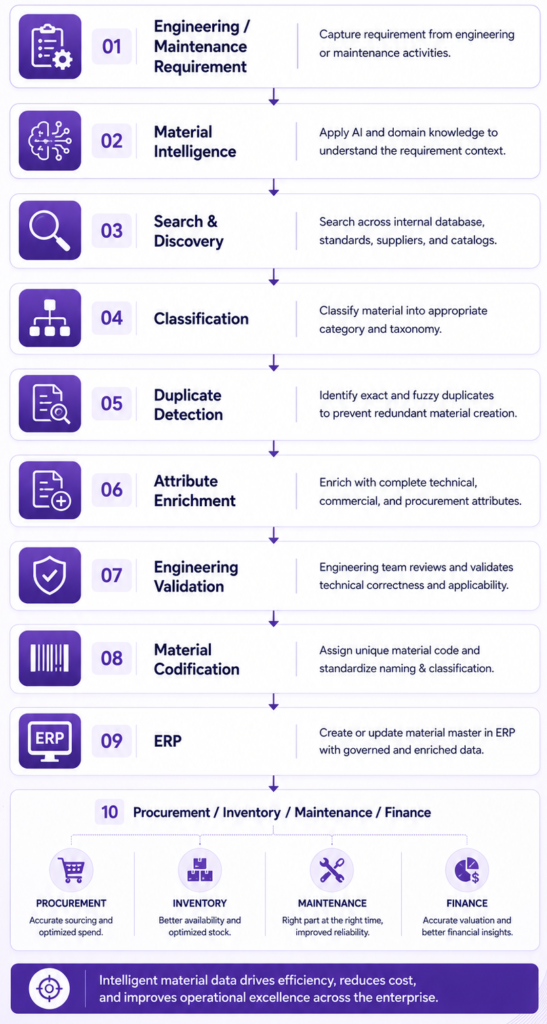
This creates a clean, well-governed foundation for downstream business processes.
Conclusion
For asset-intensive organizations such as oil & gas companies, refineries, petrochemical organizations, and process industries, material master data is not simply an ERP administrative requirement.
It directly influences:

How quickly you can keep your assets running.
ERP provides the transaction system.
But material intelligence provides the foundation that makes those transactions meaningful.
Organizations that invest in material cleansing, standardization, classification, and enrichment can move beyond simply managing material codes.
They can create an enterprise-wide, trusted material foundation that connects engineering, procurement, inventory, maintenance, supply chain, and asset management.
And that is where material master data begins to create measurable business value.

With nearly two decades of experience in engineering, I bring deep expertise across both EPC (Engineering, Procurement, and Construction) and product-based OEM environments. My core strengths lie in engineering standardization, process optimization, and technical leadership. I have consistently driven excellence through the development and implementation of robust engineering frameworks, delivering value across global industrial projects and complex product lifecycles.
