

Introduction
Your sales team is bringing in opportunities.
Your application engineering team is working hard to qualify them.
The pipeline is growing. RFQs are coming in.
But there is a problem that many engineering-driven businesses don’t talk about enough:
Your ability to respond to opportunities may be limited by your proposal capacity.
More Opportunities. More Work. Same Team.
Winning a new opportunity isn’t just about finding the customer.
Once an RFQ arrives, the real work begins.
Sales and Application Engineering teams often need to spend hours reviewing technical documents, understanding customer requirements, identifying the right solution, preparing BOMs or BOQs, estimating costs, checking specifications, preparing technical submissions, coordinating internally, and responding to clarifications.
One opportunity can consume significant engineering bandwidth.
Now multiply that by 10, 20, or 50 RFQs.
The challenge becomes obvious:
The pipeline can grow faster than the team’s ability to process it.
The Hidden Proposal Bottleneck
Imagine your sales team identifies 100 potential opportunities.
But your Sales and Application Engineering team has the capacity to prepare only 30–40 serious proposals within the required timelines.
What happens to the rest?
Some are delayed.
Some receive less attention.
Some may get a quick response instead of a carefully engineered proposal.
And some opportunities may simply be missed.
The problem isn’t necessarily a lack of leads.
The problem is the capacity to convert those leads into quality proposals.
When the Proposal Becomes the Bottleneck
In many EPC, OEM, manufacturing, and engineering businesses, proposal preparation sits at the intersection of multiple functions.
- Sales needs speed.
- Application Engineering needs technical accuracy.
- Procurement needs realistic pricing.
- Management needs commercial visibility.
- Customers need complete and compliant responses.
And everyone is working against the same deadline.
This creates a familiar cycle:
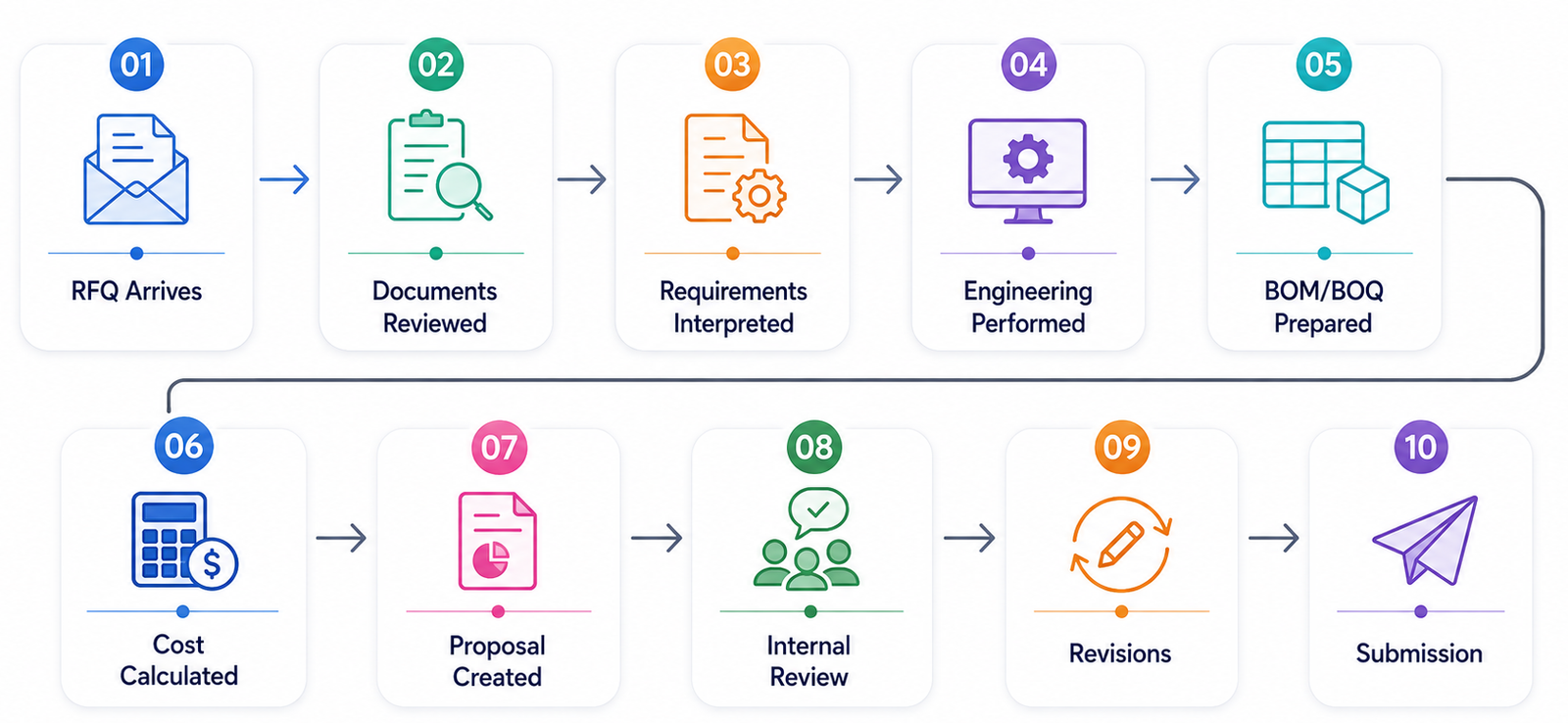
Then the next RFQ arrives.
And the cycle starts again.
What Happens When Proposal Volume Increases?
The first reaction is often:
“We need more people.”
So companies add engineers.
But as the business grows, the number of RFQs grows too.
Adding people can increase capacity, but the underlying proposal process may remain the same.
The result can be:
- More coordination
- More reviews
- More handoffs
- More repetitive work
- More pressure to respond faster
Meanwhile, competitors are also trying to shorten their response times.
The challenge is no longer simply having enough people.
It’s about how efficiently the existing engineering capacity can be used.
Speed Matters More Than Ever
Customers don’t always wait for the perfect proposal.
They may be evaluating multiple suppliers simultaneously.
A delayed response can mean:
The opportunity moves on.
A slow proposal process can therefore affect much more than productivity.
It can impact:
- Opportunity coverage
- Response time
- Sales velocity
- Engineering utilization
- Cost of sales
- Proposal quality
- Win rates
- Customer experience
- Revenue growth
That’s why proposal capacity is becoming a strategic business issue, not just an operational one.
Your Best Engineers Should Work on the Hard Problems
Application engineers bring something extremely valuable to the business:
Engineering judgment.
Their expertise should be focused on solving complex customer requirements, optimizing solutions, validating designs, and supporting the sales team on critical opportunities.
But how much of their day is actually spent doing that?
And how much is spent on repetitive activities such as:
- Searching through documents
- Copying specifications
- Recreating BOMs
- Looking up standard information
- Preparing repetitive tables
- Formatting proposals
- Revising documents
- Searching previous proposals for information
These activities are necessary.
But they don’t necessarily require your most experienced engineers to spend hours doing them manually.
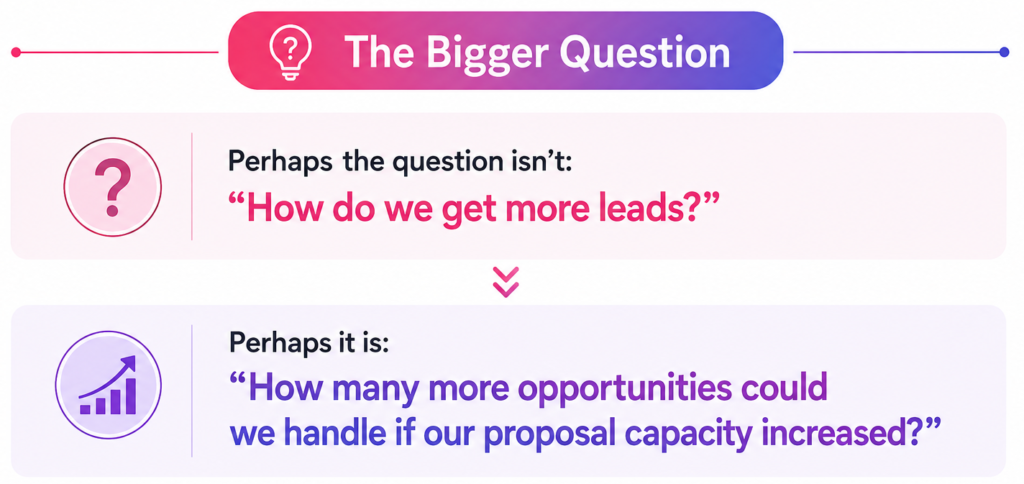
Generating opportunities is only one part of growth.
Converting opportunities into proposals quickly and accurately is another.
When proposal preparation becomes the bottleneck, increasing the top of the funnel alone won’t solve the problem.
The Future of Proposal Capacity
The companies that win tomorrow may not simply be the ones with more leads.
They may be the ones capable of responding to more opportunities, faster, without proportionally increasing their engineering workload.
The goal isn’t necessarily to make engineers work faster.
The goal is to reduce the repetitive work surrounding proposal preparation so engineering teams can focus on higher-value technical decisions.
That means asking:
How much of your proposal process can be standardized, automated, reused, or accelerated?
Because increasing proposal capacity doesn’t always mean increasing headcount.
Sometimes, it means making the existing team capable of handling more opportunities.
Conclusion
If your sales pipeline is growing but your proposal team is struggling to keep up, adding more leads may not be the answer.
The real constraint may be somewhere further down the funnel.
Your proposal capacity.
So ask yourself:
Is your business struggling to generate opportunities?
Or is it struggling to process the opportunities it already has?
You may not have a lead problem.
You may have a proposal capacity problem.

With nearly two decades of experience in engineering, I bring deep expertise across both EPC (Engineering, Procurement, and Construction) and product-based OEM environments. My core strengths lie in engineering standardization, process optimization, and technical leadership. I have consistently driven excellence through the development and implementation of robust engineering frameworks, delivering value across global industrial projects and complex product lifecycles.
