
Introduction
For an OEM, an RFQ can look deceptively simple.
A customer sends a requirement. The sales team reviews it. An application engineer identifies the right product. Pricing gets checked. A quotation goes out. On paper, it’s a short, clean sequence.
In reality, that sequence rarely stays clean once volume enters the picture. When an OEM is handling hundreds of RFQs across different products, configurations, specifications, quantities, currencies, and customer-specific terms the process starts to strain. The information needed to respond is usually scattered across product catalogues, datasheets, ERP systems, price lists, configuration rules, engineering documents, inventory records, old quotations, and CRM entries.
Teams end up spending their time searching, interpreting, checking, configuring, and calculating long before anyone actually writes the quote. The pattern becomes familiar:
More RFQs → More manual work → Longer quotation cycles
So what if that middle stretch the searching, interpreting, and calculating could largely take care of itself?
The Problem
OEMs often assume their quotation process should be simple because their products are standardized. But standardization is exactly what makes things complex. A single pump line might vary by flow, head, material, voltage, seal type, connection size, and operating conditions. A valve line might vary by type, size, pressure class, body material, trim, actuator, and certification.
The real difficulty isn’t the number of options it’s that customers rarely describe their requirements the way the OEM’s own systems expect. A customer might write “SS,” “stainless,” or “304 SS” for the same material. They might write “3PH,” “three phase,” or “415V 3~” for the same electrical spec.
This creates a quiet but constant translation problem:
Customer Language → Engineering Requirements → Product Configuration
Get that translation wrong, even slightly, and the result is a mismatched product, an incorrect configuration, or a price that doesn’t hold up.
Understanding the RFQ
Picture an RFQ that reads:
“Please quote a stainless-steel centrifugal pump suitable for 50 m³/hr at 40 m head, 415V, 3-phase, with mechanical seal.”
Normally, someone has to read that line, pull out the important details, search the catalogue, check possible models, and confirm the configuration by hand.
With a smarter quotation process, that requirement gets interpreted and converted into structured information almost immediately the product type, performance figures, material, electrical requirement, and seal type all recognized and organized. But recognizing the requirement is only the opening move. The real question that follows is: which product actually satisfies it?
Finding the Right Product
An OEM’s product range can span multiple families, models, variants, and configuration options. Instead of relying on simple keyword matching, a connected system can link the customer’s requirement directly to the relevant product information even when the customer’s wording doesn’t match the OEM’s internal terms.
“SS” becomes stainless steel. “3PH” becomes three phase. “415V 3~” becomes 415 V, three phase. A shared language forms between how the customer speaks and how the OEM’s systems are structured.
The result isn’t just a faster search. It’s a genuine connection between requirement and product one that narrows down the right family and points toward the configuration that best fits what was actually asked for. For sales and application engineering teams, this alone can eliminate a large share of time spent digging through catalogues.
Product Configuration
Selecting a product is only part of the picture. Many OEM products are configurable, and the final configuration can depend on size, material, pressure rating, seal, drive, connection, accessories, and more with some choices restricting others behind the scenes.
This is precisely why intelligent understanding can’t work alone. The requirement needs to be understood, but it’s the OEM’s own engineering rules that determine what can actually be built and supplied. Understanding provides the interpretation; the OEM’s rules provide the guardrails. Together, they produce a configuration that’s already been checked before it ever reaches the customer without forcing anyone to manually work through every rule by hand.
The Pricing
A configured product still isn’t a quotation. Final pricing depends on the base product, selected options, accessories, quantity, customer, region, currency, discounts, margins, and commercial terms details that traditionally mean chasing down multiple sources or waiting on another team to confirm.
In a connected process, the configured product links directly to the OEM’s pricing information, and the applicable rules and customer-specific terms get factored in automatically. The flow simply becomes:
Product → Configuration → Pricing → Quote
Less searching. More consistency between what was configured and what the customer is ultimately quoted.
When Something Doesn’t Fit
Not every RFQ is standard, and it shouldn’t be forced to look like one. Some requirements are ambiguous, non-standard, outside the usual range, or specific to a particular project. In those cases, the goal isn’t to automatically say “yes” it’s to recognize when something needs a second look and route it to the right engineer.
Standard requirements move through automatically. Everything else goes to the people best equipped to judge it. This isn’t about removing engineering expertise it’s about making sure that expertise is spent where it actually matters.
Generating the Quote
Once the product, configuration, and pricing are validated, the quotation can be generated directly from that approved information customer and RFQ details, product specifications, configuration, quantities, pricing, delivery, and terms, all pulled from the same source rather than rebuilt by hand at every stage.
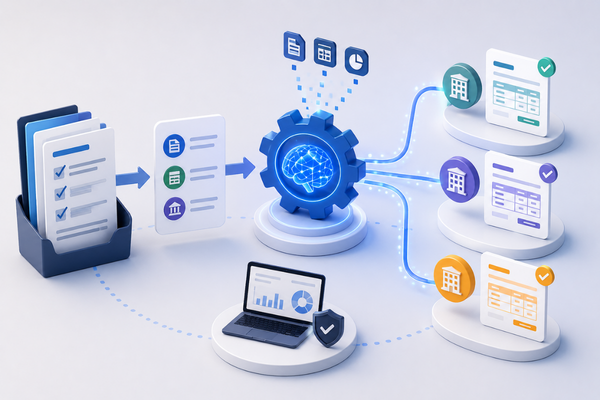
Customer Requirement → Product → Configuration → Price → Quote
What This Actually Changes
The real benefit was never just speed. It’s the disappearance of repetitive work between receiving an RFQ and responding to it. Sales teams spend less time hunting for product details. Engineers spend less time on routine requests. Pricing stays more consistent. Customers hear back faster.
The old pattern search, interpret, configure, calculate, copy, format gives way to something leaner: understand, validate, price, quote. That shift frees OEM teams to spend their time where it counts: complex requirements, customer conversations, and closing deals.
The Bigger Idea
None of this replaces the OEM’s own knowledge it works alongside it. Product data, configuration rules, pricing logic, and engineering information stay exactly where they are. What changes is the layer connecting a customer’s plain-language requirement to all of it.
The customer simply sends what they need. Somewhere in between, the complexity gets handled. What arrives back is an accurate, ready quote with the sales team free to focus on the opportunity, not the paperwork behind it.

With nearly two decades of experience in engineering, I bring deep expertise across both EPC (Engineering, Procurement, and Construction) and product-based OEM environments. My core strengths lie in engineering standardization, process optimization, and technical leadership. I have consistently driven excellence through the development and implementation of robust engineering frameworks, delivering value across global industrial projects and complex product lifecycles.
