
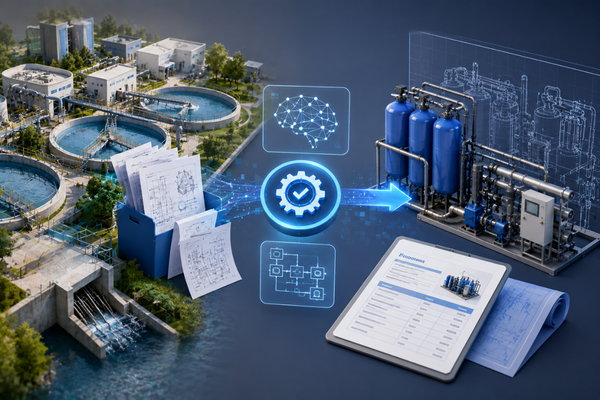
Introduction
A customer sends an RFP for a treatment plant, an STP, an ETP, maybe a full RO or ZLD system. They describe the capacity they need, the water they’re starting with, and the quality they expect at the end.
What they don’t describe is how the plant should actually be built.
That part is left entirely to the engineering team. And what follows turning a page of requirements into a fully costed, technically sound proposal is far more involved than most customers ever see.
But what happens between the RFP and the final quote?
Why Water Treatment RFPs Are Different
Most product quotations are a matching exercise: a requirement comes in, a catalogue item goes out. Water treatment doesn’t work that way.
An RFP might specify plant capacity, influent quality, effluent standards, water recovery targets, chemical requirements, utilities, and site conditions, but none of that tells anyone, on its own, what the plant should look like.
Two projects with nearly identical capacity can end up needing completely different treatment processes, simply because the incoming water is different, or the discharge standard is stricter. In water treatment, the engineering has to happen before the pricing can even begin.
Understanding the Customer Requirement
The customer provides the requirement. But who decides what needs to be designed?
Every RFP is really a puzzle written in plain language capacity figures, water quality numbers, standards, and site notes, spread across pages that weren’t written with an engineer’s checklist in mind.
Someone has to read through all of it, pull out what actually matters, and organize it into something usable: a clear picture of what the plant needs to achieve- before anyone can start deciding how.
This is where things quietly start to move faster. Instead of engineers spending hours just making sense of the document itself, that requirement can be understood and structured almost immediately, freeing up time for the part that actually needs expertise: the design.
From Requirement to Engineering Solution
A treatment process is only the beginning. What turns it into a project-ready quote?
Once the requirement is understood, it has to become an actual treatment process: a sequence of stages like pre-treatment, biological or chemical treatment, clarification, filtration, and RO, arranged in whatever order actually solves the customer’s specific water problem.
This sequence, often shown as a simple process schema, becomes the backbone of everything that follows:
Needs → Scope → Treatment → Schema
Whether the right answer involves an STP, ETP, UF, ZLD, or some combination of these, the exact reasoning behind that choice is where real engineering judgment lives. It’s not a lookup; it’s a decision, shaped by the customer’s specific water and standards.
Where Equipment and Cost Come In
A process schema is still just a concept on paper. It has to become tanks, pumps, blowers, clarifiers, filters, membrane systems, dosing units, piping, valves, and electrical panels a real, buildable equipment list.
Process → Equipment → BOQ
From there, the numbers start to matter. Water treatment costing is never just equipment price it stretches across materials, fabrication, installation, commissioning, transportation, and project overheads.
The real work happens long before the price appears.
When equipment and costing stay connected to the engineering decisions behind them, something important happens: if the process design changes, the cost reflects it automatically. Nothing gets left behind in an outdated spreadsheet.
What Happens When Requirements Don’t Fit
Not every RFP fits neatly into a standard process. Some influent conditions are unusual. Some effluent targets are unusually strict. Some sites come with constraints no template anticipated.
In these cases, the goal isn’t to force a standard answer. It’s to recognize when something needs deeper engineering judgment and route it there, rather than let it pass through as if it were routine.
This keeps engineers focused where they’re needed most: not on rebuilding the basics for every RFP, but on the requirements that genuinely demand their expertise.
From Engineering Solution to Quote
Once the process, equipment, and cost line up, the final proposal comes together: an executive summary, the scope, the proposed treatment process, equipment specifications, scope of supply, exclusions, performance guarantees, and warranty terms, all built from the same underlying engineering work.
The customer receives a complete, coherent proposal. They don’t see the layers of decisions that produced it, and they don’t need to.
The Hidden Engine Behind the Quote
Here’s where intelligence enters the picture quietly, and once.
An AI-assisted engineering layer can read through dense, unstructured RFPs, organize scattered requirements, and help connect them to the right process, equipment, and cost structure. It doesn’t replace engineering judgment. It removes the repetitive weight sitting in front of it: the reading, the organizing, the reconciling, so that judgment gets applied where it actually counts.
What’s happening underneath stays deliberately out of view. The customer sees a requirement go in and a quote come out. In between, a connected engine handles the reasoning that used to take days of manual cross-referencing.
What This Changes for Engineering Teams
The real shift isn’t just speed, though proposals do move faster. It’s what engineers get back.
Less time spent decoding requirement documents. Less time rebuilding equipment lists from scratch. Less time reconciling design changes with cost sheets that were already sent out for approval. More time on the decisions that genuinely require an engineer’s judgment: unusual influent conditions, tight discharge standards, site-specific constraints.
Proposals become more consistent across projects, because the underlying structure doesn’t reset every time. And companies can respond to more RFPs within tighter timelines, without stretching their engineering teams thinner to do it.
Conclusion
Water treatment RFPs will always demand real engineering before they can become accurate quotes; that part doesn’t change and shouldn’t.
What can change is how much of the surrounding work reading, organizing, connecting process to equipment, connecting equipment to cost happens invisibly, instead of consuming an engineer’s entire week.
The shift is simple to describe, even if the mechanics behind it aren’t: from document-based RFP handling, where every proposal starts from a blank page, to a connected engineering-to-quote process, where the customer’s requirement flows straight through to a proposal that’s accurate, consistent, and ready faster than before.
The customer provides the requirements. The system does heavy lifting behind the scenes. The engineering quote arrives accurate, complete, and ready to send.

With nearly two decades of experience in engineering, I bring deep expertise across both EPC (Engineering, Procurement, and Construction) and product-based OEM environments. My core strengths lie in engineering standardization, process optimization, and technical leadership. I have consistently driven excellence through the development and implementation of robust engineering frameworks, delivering value across global industrial projects and complex product lifecycles.
