
Introduction
For construction companies, responding to a tender is rarely as simple as preparing a quotation.
A single tender can contain hundreds or even thousands of pages covering drawings, BOQs, technical specifications, scope of work, schedules, contract conditions, material requirements, standards, and commercial terms. Teams then have to understand the project, identify requirements, analyze quantities, estimate costs, check compliance, and prepare the final proposal.
The problem is not always a lack of expertise.
The problem is the amount of information that teams have to process before they can make a decision.
This is where AI-powered tender-to-proposal automation is changing the way construction companies approach bidding.
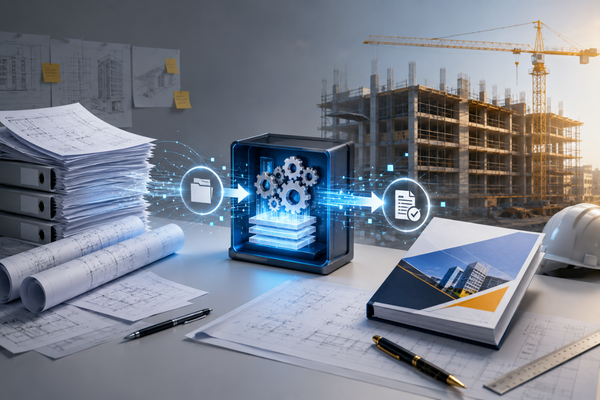
Instead of treating a tender as a collection of separate PDFs, spreadsheets, drawings, and documents, AI can turn that information into a connected project model linking requirements to scope, BOQ, materials, costs, compliance, and finally the proposal.
Tender Documents → Analyze → Needs → Engineering → BOQ → Suppliers → Costing →Proposal
But what does this actually change for a construction company?
Why Construction Tendering Takes So Much Time
A construction tender rarely keeps all its important information in one place.
The scope may be described in the tender document. Quantities may be listed in the BOQ. Technical requirements may appear in specifications, while important conditions can be hidden inside drawings, schedules, or contract documents.
This means estimators and engineers constantly move between documents to understand what the client actually expects.
The challenge becomes even greater when a tender contains hundreds or thousands of BOQ lines.
Teams need to identify quantities, units, specifications, materials, work categories, and associated requirements before they can even begin accurate costing.
And some of the most important requirements may not appear in the BOQ at all.
A missing requirement in a technical specification or contract condition can later become a cost risk, compliance issue, or execution problem.
So the real challenge is not simply reading documents.
It is connecting information across documents and understanding what it means for the project.
From Tender Documents to Commercial Proposal Automatically
What if you could upload a construction tender and get a commercial proposal without manually going through every document?
That is where AI-powered tender automation changes the traditional tendering process.
Instead of spending hours opening tender documents, searching for requirements, analysing BOQs, checking specifications, and preparing information for different teams, you simply provide the tender information to the system.
Then AI takes over.
The system understands the tender and turns the information into a structured project view. It identifies what matters, connects the relevant project information, and prepares it for estimation and proposal generation.
You don’t need to manually work through every stage.
You simply move from:
Tender Documents → AI → Commercial Proposal
The complexity happens in between.
And that is the interesting part.
The system can use the information inside the tender to support project understanding, costing, compliance, and proposal preparation without forcing the user to manage every individual step manually.
By the time the commercial proposal is generated, the information has already been connected and organized into a form that can support pricing and final submission.
From Hundreds of Pages to One Proposal
A construction tender may contain hundreds or even thousands of pages.
Instead of making your team spend hours finding the information hidden inside them, AI can process the tender as a complete project rather than treating every document separately.
The goal is simple:
Give AI the tender. Get a structured, proposal-ready output.
What happens in between is where intelligence works.
The Result?
Less manual searching.
Less repetitive data entry.
Less switching between documents.
Less time spent preparing information.
And more time for your team to focus on what matters:
Making the right engineering and commercial decisions.
This is where tender-to-proposal automation moves beyond document processing.
It turns a complex tender into a proposal-ready project intelligence workflow.
From Documents to a Digital Project Model
The real value of tender automation goes beyond reading documents faster.
The bigger opportunity is creating a digital representation of the tender.
Instead of having disconnected PDFs, Excel files, Word documents, and drawings, the system can create a structured project model containing requirements, scope, BOQ, quantities, materials, resources, engineering information, costs, compliance, and proposal data.
This creates traceability.
A team can trace a proposal requirement back to the relevant project information and, ultimately, to the original tender source.
That means the tender becomes more than a document set.
It becomes structured project intelligence.
What Changes for Construction Companies?
AI’s goal is not to replace estimators, engineers, procurement teams, or commercial professionals. It is to reduce the amount of time they spend on repetitive information-processing work.
Instead of:
Read → Search → Copy → Calculate → Prepare
the process can move toward:
Understand → Structure → Engineer → Cost → Validate → Generate
Teams can spend more time on engineering decisions, commercial strategy, risk evaluation, and improving the competitiveness of the bid.
AI handles the high-volume information processing that traditionally consumes much of the tender preparation cycle.
Conclusion
Construction tendering is becoming increasingly complex.
Large document volumes, detailed technical requirements, extensive BOQs, and tight submission deadlines make traditional tender preparation difficult to scale.
The real value is not simply generating a proposal faster.
It creates a structured understanding of the tender that can support estimation, engineering, procurement, commercial decisions, and proposal preparation.
For construction companies handling a growing volume of tenders, this can turn tendering from a document-heavy activity into a more intelligent, traceable, and scalable process.

Palanivel Muthusamy is a seasoned expert in the Engineering, CAD, CAE, PLM, and PDM domains, boasting over 20 years of experience in project and product engineering within industrial companies. He holds both a Bachelor’s and a Master’s degree in Engineering, complemented by numerous certifications. Palanivel is highly proficient in engineering processes, including engineering change orders, notices, and quality processes, bringing a wealth of knowledge and hands-on expertise to the field.
