
Bringing AI, Engineering Knowledge, and Governance Together
For decades, ERP systems have been the backbone of manufacturing operations.
They manage:
- Purchasing
- Inventory
- Finance
- Maintenance
- Production
But one challenge has persisted across industries:
ERP systems were never designed to become engineering knowledge platforms.
An ERP material master stores information.
It doesn’t understand engineering.
It cannot compare two pumps technically.
It cannot interpret a datasheet.
It cannot detect engineering similarities hidden inside specifications.
This is where IEHUB fills the gap.
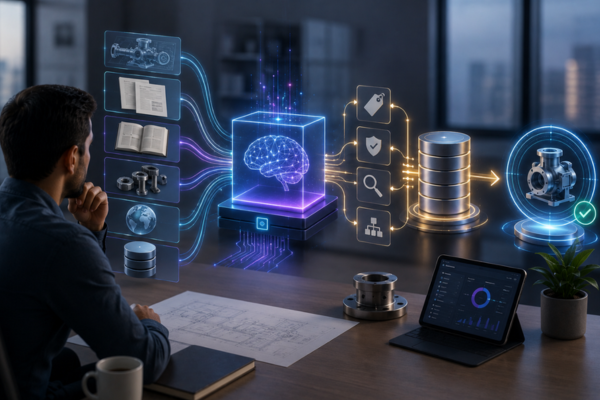
Rather than replacing ERP, IEHUB becomes the intelligent layer that prepares, enriches, validates, and governs material information before it enters ERP.
AI-Driven Similarity Search
One of the largest causes of duplicate materials is simple.
People cannot find what already exists.
An engineer searches:
- “Centrifugal Pump”
- “Pump 450 m³/hr”
- “Cooling Water Pump”
All three may refer to the same equipment.
Traditional ERP keyword search often misses these relationships.
IEHUB analyzes:
- ERP metadata
- Engineering specifications
- Historical documents
- Equipment history
- Installed assets
- Technical attributes
Instead of matching words, it identifies engineering similarity.
The result:
- Existing equivalent materials
- Approved alternatives
- Cross-plant reuse
- Reduced duplicate creation
Technical Knowledge Management
Engineering decisions depend on technical content, not just descriptions.
A single pump may include:
- Performance curves
- Datasheets
- GA drawings
- Motor specifications
- Seal documentation
- Maintenance manuals
- Vendor certificates
ERP stores references.
IEHUB manages engineering knowledge.
Engineers can retrieve complete technical context while evaluating materials.
This significantly improves:
- Equipment selection
- Design quality
- Maintenance planning
- Engineering consistency
Collaboration Across Departments
Material creation is not an individual activity.
It involves multiple stakeholders.
- Engineering defines technical requirements.
- Procurement validates suppliers.
- Master Data standardizes naming.
- Governance ensures compliance.
- Approvers verify completeness.
Instead of exchanging emails and spreadsheets, IEHUB supports structured collaboration throughout the lifecycle.
Each participant contributes only within their area of expertise.
The result is faster approvals and better-quality master data.
Governance That Prevents Bad Data
Governance is more than approvals.
It ensures consistency before ERP creation.
Typical governance checks include:
- Naming standards
- Duplicate verification
- Mandatory attributes
- Documentation completeness
- Classification validation
- Ownership assignment
Only after these checks pass does material creation proceed.
PLM and CAD Integration
A common engineering problem occurs during design.
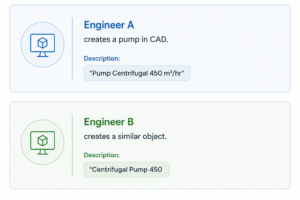
ERP later receives:
- Another request
- Another description
- Another material
Eventually:
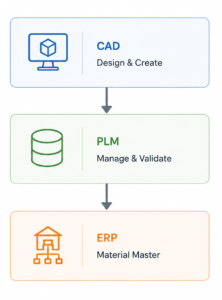
Contain different descriptions for identical equipment.
The BOM becomes inconsistent.
Procurement spends additional effort mapping engineering data to ERP.
IEHUB closes this gap.
By connecting engineering systems with governed material information, metadata stays synchronized throughout the design lifecycle.
Creation Request Management
Instead of informal requests, IEHUB provides structured workflows.
A request progresses through defined stages:
- Submission
- Enrichment
- Review
- Duplicate analysis
- Governance
- Approval
- ERP creation
Every action is logged.
Every decision is traceable.
This creates a complete audit trail for compliance and quality management.
AI-Based Supplier Discovery
Selecting suppliers involves more than searching by name.
Using technical specifications, IEHUB can identify:
- Equivalent manufacturers
- Regional suppliers
- Approved vendors
- Alternate products
- Sourcing opportunities
Procurement gains faster access to qualified suppliers without starting from scratch.
The Business Impact
Organizations implementing intelligent material governance can expect improvements in:
Engineering
- Faster design reuse
- Better technical consistency
- Less duplicated effort
Procurement
- Improved supplier standardization
- Better spend consolidation
- Faster RFQ generation
Master Data
- Fewer duplicate materials
- Higher-quality descriptions
- Consistent classifications
Maintenance
- Easier spare part identification
- Improved asset reliability
- Better inventory visibility
Leadership
- Higher data quality
- Lower inventory costs
- Better reporting
- Stronger governance
Why IEHUB Complements ERP
ERP remains the system of record.
IEHUB becomes the system of intelligence.
Together, they create a modern material management ecosystem where:
- AI finds similar materials.
- Engineering enriches technical content.
- Governance ensures quality.
- Collaboration accelerates approvals.
- ERP executes business transactions.
Rather than forcing ERP to solve problems it was never designed for, organizations can leverage IEHUB to ensure only high-quality, duplicate-free, and fully governed material data reaches ERP.
Conclusion
Digital transformation is not simply about implementing new software; it’s about improving the quality of the information that drives every business process.
By combining AI-powered similarity search, technical knowledge management, governance, collaboration, and seamless integration with PLM, CAD, and ERP, IEHUB enables organizations to transform material master management from a reactive administrative task into a strategic capability.
The result is a smarter engineering workflow, cleaner ERP data, reduced operational costs, and a scalable foundation for future innovation.
With nearly two decades of experience in engineering, I bring deep expertise across both EPC (Engineering, Procurement, and Construction) and product-based OEM environments. My core strengths lie in engineering standardization, process optimization, and technical leadership. I have consistently driven excellence through the development and implementation of robust engineering frameworks, delivering value across global industrial projects and complex product lifecycles.
