
From Material Demand to ERP-Ready: Building a Smarter Material Lifecycle
Every manufacturing organization depends on accurate material master data. Yet many still follow a process that creates duplicate records, inconsistent descriptions, and poor procurement decisions.
Whether it’s a refinery, manufacturing plant, pharmaceutical facility, mining operation, or EPC company, the situation is often the same:
- An engineer needs a valve.
- Maintenance requires a replacement motor.
- Procurement receives a request for a bearing.
- A project team urgently needs a pump.
The immediate response is usually:
“Let’s create a new material in ERP.”
While this seems like the fastest solution, it often leads to long-term data quality issues. ERP systems are built to manage transactions, not to discover, validate, enrich, and govern engineering materials before they become master data.
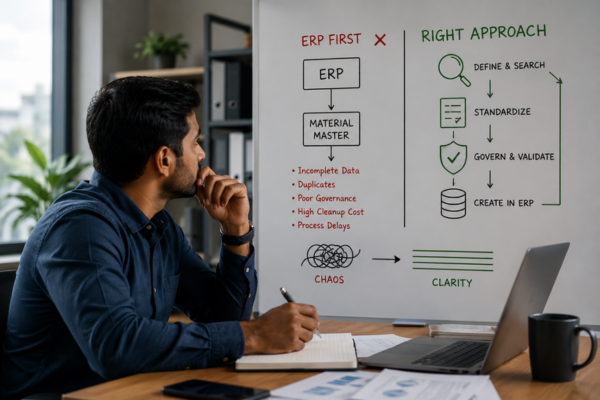
Instead of making ERP the starting point, organizations should treat it as the final destination of a well-governed material lifecycle.
The Hidden Problem with Traditional Material Creation
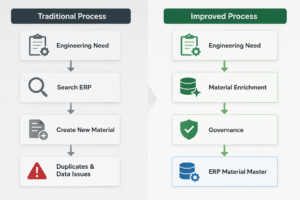
In many organizations, the material creation process looks like this:
Engineering Need → ERP Search → No Match Found → New Material Request → Material Created
Months later, someone discovers:
- The material already existed.
- Another plant was using the same equipment.
- An approved supplier has already been identified.
- A better specification was available.
The consequences are significant:
- Duplicate material records
- Excess inventory
- Fragmented procurement
- Inconsistent naming
- Poor reporting and analytics
- Higher maintenance and operating costs
The problem isn’t the ERP system itself.
The real issue is that ERP receives incomplete and unvalidated engineering information.
The Smarter Approach: A Structured Material Lifecycle
Rather than creating materials immediately, organizations should guide every request through a structured lifecycle before it reaches ERP.
This process transforms a simple engineering requirement into a standardized, duplicate-free, ERP-ready material.
Stage 0: Capturing the Material Demand
Every material starts with a business need, not a material master.
Examples include:
- A design engineer requires a valve.
- Maintenance needs a replacement motor.
- A project team needs equipment for costing.
- Procurement receives a supplier’s recommendation.
- Long-lead equipment requires evaluation.
At this point, requests are usually incomplete.
Typical requests sound like:
- “Need a centrifugal pump.”
- “Looking for a bearing.”
- “Valve for cooling water.”
These requests lack the technical information required for ERP.
ERP cannot determine:
- Which manufacturer?
- Which pressure class?
- Which material grade?
- Which standard?
- Does an equivalent already exist?
At this stage, the goal is simply to capture the engineering requirement, not to create a material.
Stage 0.3: Enriching the Material Information
Once the demand is captured, the next step is enrichment.
Instead of immediately creating a material, engineering teams gather the technical information required to make informed decisions.
This includes:
Identifying Technical Attributes
For example:
Pump
- Flow rate
- Head
- Material
- Seal type
- Motor power
- Voltage
Valve
- Size
- Pressure class
- Body material
- Trim
- End connection
Motor
- Power
- RPM
- Voltage
- Frame size
- Protection class
Identifying Approved Manufacturers
Engineering and procurement review:
- Existing approved suppliers
- Preferred manufacturers
- Alternative vendors
Reviewing Technical Documentation
Relevant documents such as:
- Datasheets
- Specifications
- Drawings
- Vendor catalogs
Are attached to the request.
Searching for Similar Materials
This is one of the most valuable steps.
Instead of asking:
“Create a new pump.”
The system asks:
“Do we already have a similar pump?”
Finding existing or equivalent materials dramatically reduces duplicate creation and unnecessary purchases.
Stage 0.7: Applying Governance
Once the technical information is complete, governance ensures the material meets organizational standards before entering ERP.
Key governance activities include:
Standardized Naming
Instead of multiple names like:
- Pump
- Water Pump
- CENT Pump
- Pump Centrifugal
Organizations define one approved naming convention.
Duplicate Verification
Similarity searches are performed again to ensure no equivalent material already exists.
Technical Validation
Engineering verifies:
- Mandatory attributes
- Specifications
- Supporting documents
- Supplier information
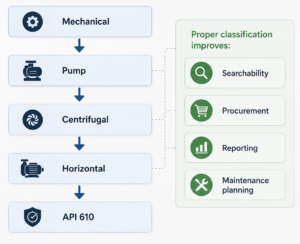
Material Classification
The material is classified using a consistent taxonomy.
Example:
Ownership Assignment
Every material should have a designated owner responsible for maintaining its quality throughout its lifecycle.
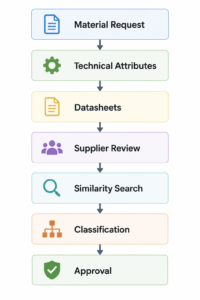
Visual Flow:
Stage 1: ERP-Ready Material
Only after enrichment and governance should the material be created inside the ERP.
At this stage, the material contains:
- Standardized material name
- Complete description
- Approved classification
- Technical specifications
- Validated suppliers
- Supporting documents
- Assigned ownership
- Duplicate verification
Now ERP can perform the tasks it was designed for:
- Inventory Management
- Procurement
- Production Planning
- Maintenance
- Finance
- Supply Chain Operations
Instead of creating master data, ERP is now consuming trusted, high-quality information.
Why Eliminating Duplicate Materials Matters
Duplicate materials create hidden operational costs across the business.
Some common impacts include:
Excess Inventory
Identical materials are stocked multiple times, increasing inventory investment.
Procurement Inefficiencies
Purchasing teams lose the ability to consolidate spending and negotiate better supplier contracts.
Maintenance Delays
Technicians spend more time identifying the correct spare parts, leading to longer downtime.
Poor Business Reporting
Reports become unreliable when similar materials exist under multiple names and descriptions.
Visual Timeline
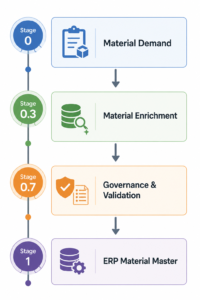
Below the timeline, include a table like:
| Stage | Key Question |
| 0 | What do we need? |
| 0.3 | What exactly is it? |
| 0.7 | Is it governed correctly? |
| 1 | Is it ready for ERP? |
Benefits of a Structured Material Lifecycle
Organizations that adopt this approach gain measurable improvements across engineering, procurement, and operations.
Some of the key benefits include:
- Higher material master data quality
- Reduced duplicate materials
- Faster engineering decisions
- Better procurement efficiency
- Lower inventory investment
- Improved supplier collaboration
- Consistent naming standards
- Easier audits and Compliance
- More reliable reporting and analytics
Final Thoughts
Creating a material should never be the first step; it should be the last.
The real value lies in everything that happens before ERP:
- Understanding the engineering requirement
- Enriching technical information
- Validating specifications
- Eliminating duplicates
- Applying governance
When organizations treat ERP as the destination rather than the starting point, they create cleaner master data, reduce operational costs, and establish a scalable foundation for digital engineering and enterprise operations.
A well-governed material lifecycle doesn’t just improve data quality; it enables smarter decisions across the entire business.

Karthik S is our in-house Master Data Quality Manager certified by ISO-8000 for Data Quality and Enterprise Master Data. He comes with 10+ years of experience with prior experience in handling customer, asset & engineering data, improving data quality & accessibility, eliminating data loss and standardizing data to match industry standards.
